🌰 Carpological Monograph: Fruit Classification
A rigorous scientific taxonomy of arboreal fruit types across temperate forest families. Details dry indehiscent fruits (samaras, true nuts, achenes), dry dehiscent capsules and legumes, fleshy drupes, pomes, and aggregate fruits with comparative diagnostic identification matrices.
In the botanical discipline of carpology (the study of fruits and seeds), a fruit is scientifically defined as the mature, ripened ovary of an angiosperm flower, encompassing the seeds and any closely associated floral or accessory tissues. While everyday culinary language loosely uses the term ‘fruit’ to denote sweet, edible produce, systematic dendrology recognizes that every broadleaf tree produces fruit—ranging from the dry, winged samaras of maples and ashes to the rock-hard acorns of oaks, the woody capsules of sweetgums, and the fleshy drupes of cherries.
The morphology of tree fruits represents an extraordinary evolutionary archive of ecological adaptations to seed dispersal vectors. Dispersal strategies fall into major syndromes: anemochory (dispersal by wind), zoochory (dispersal by animals via ingestion or caching), hydrochory (dispersal by water), and autochory (explosive mechanical self-dispersal). For the field dendrologist, fruit morphology is an infallible diagnostic asset: unlike leaves, which can be altered by shade or browsing, the structural anatomy of pericarps, sutures, wings, and seed coats is strictly dictated by genetic heredity. This monograph delivers an exhaustive carpological breakdown of global tree fruit types, comparative diagnostic keys, and their functional ecologies.
1. Carpological Architecture: The Anatomy of the Pericarp
To identify tree fruits accurately, one must understand the three fundamental layers of the fruit wall, collectively termed the pericarp, which develops from the ovary wall following fertilization:
- Exocarp (Epicarp): The outermost skin or boundary layer of the fruit. In cherries and plums, it forms the smooth outer skin; in walnuts and hickories, it contributes to the fibrous or leathery outer husk; in acorns, it forms the hard, shiny outer shell.
- Mesocarp: The middle layer of the fruit wall. In fleshy fruits (such as peaches and persimmons), the mesocarp is succulent, fleshy, and packed with sugars; in dry fruits (such as samaras and nuts), it is thin, dry, fibrous, or heavily lignified.
- Endocarp: The innermost boundary enclosing the seed cavity (locule). In drupes (such as Black Cherry), the endocarp is heavily sclerified and stone-like (the ‘pit’); in pomes (such as Apple and Serviceberry), the endocarp forms a cartilaginous or papery core; in true nuts, the endocarp is fused seamlessly with the mesocarp and exocarp.
| Fruit Botanical Class | Pericarp Consistency | Dehiscence (Splits Open?) | Seed Count | Primary Dispersal Vector | Representative Tree Genera |
|---|---|---|---|---|---|
| Samara (Single) | Dry, fibrous; expanded into wing | Indehiscent (Does not split) | 1 (rarely 2) | Anemochory (Wind gliding) | Fraxinus (Ash), Ulmus (Elm), Betula |
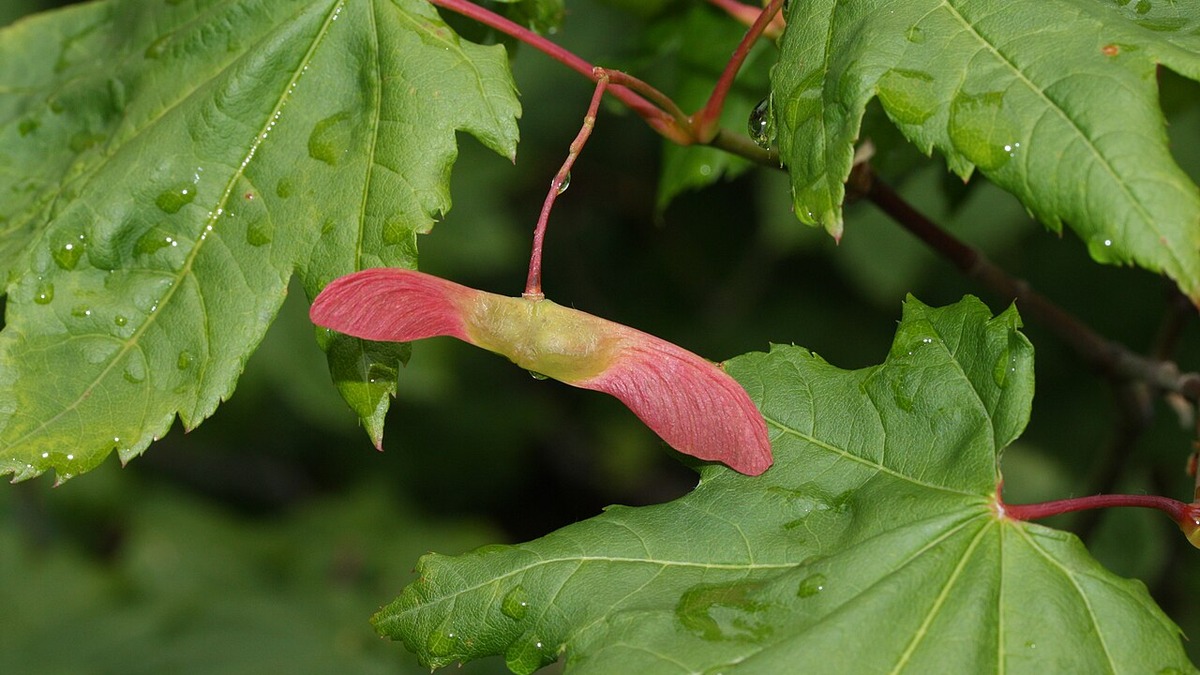
| Double Samara (Schizocarp) | Dry, winged; splits into 2 mericarps | Schizocarpic (Splits at center) | 2 seeds (1 per wing) | Anemochory (Autorotation) | Acer (All Maples) |
| Acorn (Glans) | Hard, leathery/woody pericarp | Indehiscent; seated in cupule | 1 large seed (high starch) | Zoochory (Squirrels, jays, rodents) | Quercus (All Oaks) |
| True Nut | Stony, woody pericarp throughout | Indehiscent; enclosed in involucre | 1 seed (rarely 2) | Zoochory (Caching) | Fagus (Beech), Castanea (Chestnut) |
| Drupe (Stone Fruit) | Fleshy mesocarp, stony endocarp pit | Indehiscent (Eaten whole) | 1 single seed inside pit | Endozoochory (Birds, mammals) | Prunus (Cherry), Nyssa, Cornus |
| Pome | Fleshy hypanthium, papery/stony core | Indehiscent | Multiple seeds in core | Endozoochory (Mammals) | Malus (Crabapple), Amelanchier, Sorbus |
| Legume (Pod) | Dry, elongated; 2 longitudinal sutures | Dehiscent (Splits along 2 seams) | Multiple seeds in linear row | Gravity / Zoochory | Cercis (Redbud), Robinia, Gleditsia |
| Multiple Fruit | Coalescence of ovaries from MANY flowers | Variable; fleshy or woody head | Multiple seeds embedded | Water, mammals | Morus (Mulberry), Platanus, Liquidambar |
2. Dry Indehiscent Fruits: Samaras, Acorns, and True Nuts
Dry indehiscent fruits do not split open at maturity; the entire fruit functions as the dispersal unit, relying upon external weathering or animal teeth to liberate the seed inside:
1. Samaras (Winged Achenes): A dry, single-seeded fruit in which the ovary wall expands into an asymmetrical, flattened, fibrous or papery wing. In Ashes (Fraxinus), the samara is paddle-shaped, with the elongated wing extending from the tip of a cylindrical seed cavity. In Elms (Ulmus), the samara is wafer-like, circular or elliptic, with the central seed entirely surrounded by a membranous, notched papery wing. In Maples (Acer), fruits are double samaras (schizocarps) that split at maturity into two autorotating single samaras.
2. Acorns (The Involucre-Nut Complex): The iconic fruit of the genus Quercus. Botanically, an acorn is a specialized nut formed from a three-carpellate ovary, in which two ovules abort and a single ovule expands into a massive, nutrient-dense seed. The base of the nut is encased in a cup-shaped cupule derived from hundreds of coalesced, hardened floral bracts. In White Oaks, acorns mature in a single season and possess low tannins; in Red Oaks, acorns require two full seasons to mature and carry high concentrations of bitter, astringent polyphenols.
3. True Nuts (Beechnuts, Chestnuts, and Hazelnuts): In strict botanical terminology, a true nut is a dry, indehiscent, one-seeded fruit with a woody, stony pericarp throughout, derived from a compound ovary and enclosed within a leafy or spiny involucre (husk). In American Beech (Fagus grandifolia), the woody involucre is covered in soft, hooked prickles; in autumn, it splits into four valves, revealing two sharply triangular, lustrous brown nuts. In American Chestnut (Castanea dentata), the involucre is an impenetrable, dense sphere armed with needle-sharp, branching spines that bursts open in autumn to discharge two or three sweet, flattened nuts.
The Hickory and Walnut Dilemma: Tryma vs. Pseudodrupe
For centuries, botanists debated the classification of Hickory nuts (Carya) and Walnuts (Juglans). While commonly called ‘nuts,’ they are technically trymas or drupaceous nuts (pseudodrupes). In Shagbark Hickory, the thick, green, aromatic outer husk is derived from non-ovarian floral involucre tissue; at maturity, this husk splits cleanly along four vertical sutures, dropping the smooth, bony, four-angled true nut within. In Black Walnut (Juglans nigra), the fleshy, green, intensely aromatic outer husk contains allelopathic juglone; it does not split open naturally, requiring microbial decomposition on the damp ground to expose the dark, deeply furrowed, rock-hard nut within.
3. Fleshy Fruits: Drupes, Pomes, and Aggregate Structures
Fleshy fruits are designed to entice vertebrate animals to consume them, utilizing the animal as a mobile dispersal agent that transports seeds away from the parent tree canopy:
1. Drupes (Stone Fruits): Characterized by a fleshy, sugary mesocarp enclosing a heavily lignified, stony endocarp (the ‘pit’ or ‘stone’) containing the seed. In Black Cherry (Prunus serotina), pea-sized dark purple drupes hang in elongated clusters, providing an essential autumn fat-and-sugar feast for migrating passerine birds. In Black Tupelo (Nyssa sylvatica), dark blue-black oblong drupes are borne on slender peduncles, eagerly sought by wild turkeys and black bears. In Flowering Dogwood (Cornus florida), clusters of oval, bright scarlet drupes provide high-lipid nutrition for over 35 bird species.
2. Pomes (Accessory Fleshy Fruits): Characteristic of the subtribe Pyrinae in the rose family Rosaceae, including Apples and Crabapples (Malus), Hawthorns (Crataegus), Mountain-ashes (Sorbus), and Serviceberries (Amelanchier). In a pome, the succulent flesh is not derived from the ovary wall; it is formed from the swollen, fleshy hypanthium (floral tube) that encloses the central ovary. Slicing through an apple or serviceberry reveals the cartilaginous, star-shaped core (the true endocarp) containing the seeds.
3. Aggregate and Multiple Fruits:
- Aggregate Fruits: Formed from a single flower that contains multiple separate ovaries (pistils). In Tuliptree (Liriodendron) and Magnolias (Magnolia), the fruit is an aggregate cone of samaras or follicles. In Magnolia virginiana, the aggregate cone dries in autumn, cracking open to suspend bright red, fleshy seeds on delicate, elastic, thread-like strands of vascular tissue (funiculi) that sway in the breeze to attract birds.
- Multiple Fruits: Formed from the fused ovaries of an entire cluster of flowers (an inflorescence). In American Sycamore (Platanus occidentalis), the spherical hanging ‘buttonball’ is a multiple fruit composed of hundreds of tightly packed, hairy achenes. In Sweetgum (Liquidambar styraciflua), the spiny, woody ‘gumball’ is a multiple fruit of two-beaked dehiscent capsules.
4. Dehiscent Dry Fruits: Legumes and Capsules
Dehiscent fruits dry upon maturity and mechanically split open along pre-determined suture lines, releasing their seeds into the immediate environment:
- Legumes (Pods): The definitive fruit of the family Fabaceae. Formed from a single monocarpellate ovary, a legume splits open along two distinct longitudinal sutures (the dorsal and ventral seams). In Eastern Redbud (Cercis canadensis), flat, papery, brown pods persist on bare winter branches, rattling in high winds. In Black Locust (Robinia pseudoacacia), smooth, dark brown pods split and twist spirally, launching hard-coated seeds. In Honeylocust (Gleditsia triacanthos), enormous, twisted, strap-like pods measuring up to 40 centimeters long contain sweet, sticky, edible pulp that historically attracted extinct Pleistocene megafauna (mastodons and ground sloths) for seed dispersal.
- Capsules: Formed from a compound ovary with multiple carpels, splitting along several longitudinal seams. In Horsechestnut (Aesculus hippocastanum), the fruit is a heavy, leathery, spiny three-valved capsule that splits open in autumn to drop one to three massive, lustrous, mahogany-brown seeds (‘conkers’). In Catalpa (Catalpa speciosa), the fruit is an enormous, pencil-thin capsule up to 50 centimeters long, filled with hundreds of papery seeds fringed with delicate white hairs.
5. Seed Dormancy and Stratification Protocols in Silviculture
From an arboricultural propagation and silvicultural nursery perspective, gathering ripe forest fruit is merely the first step. Seeds of temperate trees rarely germinate immediately; they possess complex dormancy mechanisms designed to prevent germination during autumn when approaching winter frosts would kill tender seedlings:
- Exogenous Physical Dormancy (Hard Seed Coats): Found in Black Locust and Kentucky Coffeetree. The seed coat is impermeable to water. Nursery managers must execute mechanical scarification (nicking the coat with a file) or acid scarification (immersion in concentrated sulfuric acid for 20 to 60 minutes) to etch the coat and permit water imbibition.
- Endogenous Physiological Dormancy (Chilling Requirement): Found in oaks, maples, cherries, and conifers. The seed embryo is inhibited by high concentrations of abscisic acid (ABA). Breaking dormancy requires cold moist stratification: mixing seeds with damp peat moss or sand and maintaining them at 1 to 4 degrees Celsius for 60 to 120 days. This simulates winter chilling, triggering endogenous gibberellin synthesis that catalyzes spring germination.
By understanding fruit morphology, dispersal ecology, and seed dormancy genetics, foresters and arborists successfully preserve, propagate, and restore diverse woodland ecosystems across global landscapes.
6. Endozoochory Mutualisms: Blue Jays, Acorn Woodpeckers, and Oak Dispersal
The evolutionary success of large, heavy, single-seeded tree fruits (such as acorns, beechnuts, and hickory nuts) relies entirely upon specialized mutualistic relationships with scatter-hoarding animals—a dispersal syndrome termed synzoochory.
In North American deciduous forests, the Blue Jay (Cyanocitta cristata) operates as the primary silvicultural engineer of oak dispersal. In autumn, an individual Blue Jay can collect, transport, and cache between 3,000 and 5,000 acorns, frequently carrying three to five acorns simultaneously in its expandable esophageal throat pouch. Blue Jays fly these acorns up to one to five kilometers away from the parent tree, preferentially burying them in open, disturbed forest clearings, old abandoned agricultural fields, and woodland margins at depths of two to four centimeters in moist mineral soil—the exact optimal burial depth and light regime required for successful oak acorn germination. Because jays retrieve only a fraction of their cached acorns during winter, thousands of forgotten acorns germinate in subsequent springs, driving rapid post-glacial northward migrations of oak forests across continents.
7. Seed Predation by Granivorous Weevils and Microbial Decay
Counterbalancing mutualistic dispersal is intense, lethal seed predation by specialized invertebrates and pathogens. Chief among these are the acorn and nut weevils (genus Curculio, family Curculionidae). Female Curculio weevils possess an elongated, slender snout (rostrum) that exceeds their entire body length, tipped with tiny, chewing mandibles.
In mid-summer, while acorns and hickory nuts are still green and soft on the tree canopy, the female weevil drills a microscopic channel through the hard pericarp and deposits an egg into the embryonic cotyledon. The legless larva hatches and consumes the nutritious starch and lipid reserves from within. In late autumn, following fruit drop, the mature fat larva chews a perfectly circular, 2-millimeter exit hole through the shell, burrows into subterranean soil to pupate, leaving behind an empty, non-viable, hollow nut shell. In non-mast years, weevil infestation rates can destroy up to 80 to 95 percent of the total acorn crop, reinforcing the evolutionary imperative of synchronized masting cycles to overwhelm weevil populations.
8. Ethnobotany of Wild Pomaceous and Drupaceous Tree Fruits
Throughout human evolutionary history, wild tree fruits have served as indispensable dietary staples and medicinal resources. Indigenous cultures across North America actively managed wild fruit orchards through selective coppicing and localized prescribed burning to promote serviceberry (Amelanchier), hawthorn (Crataegus), and wild plum (Prunus) production.
Serviceberries—known regionally as juneberries, saskatoons, or sugarplums—were the vital ingredient in pemmican, the calorie-dense survival food made by pounding dried berries together with rendered bison tallow and dried meat. Biochemical analysis demonstrates that wild pomes and drupes contain significantly higher concentrations of polyphenolic antioxidants, vitamin C, anthocyanins, and dietary fiber than modern hybridized commercial orchard fruits, testifying to the nutritional richness of native woodland trees.