AUTUMN WOODLAND FIELD GUIDE / TREE IDENTIFICATION
A Field Guide to the Fruits and Seeds Beneath Our Trees
From oak acorns and glossy conkers to spinning maple helicopters, learn how to recognize common tree fruits across American and British woodlands.
A walk through a woodland or neighborhood park can reveal a remarkable collection of natural objects beneath the trees.
There may be acorns resting among fallen oak leaves, glossy brown conkers scattered across a path, or winged seeds spinning toward the ground.
These objects are easy to overlook, yet they provide valuable clues about the trees growing nearby.
They also reveal how different tree species reproduce and spread into new areas.
In the United States and United Kingdom, many familiar trees produce distinctive fruits that can be recognized by their shape, texture, and structure.
Learning to identify tree fruits is one of the simplest ways to improve your tree identification skills, especially during autumn when many species release their seeds.
This guide explores common examples, explains the differences between fruits and seeds, and shows how to identify them responsibly.
What Counts as a Tree Fruit?
In everyday language, the word fruit often brings to mind apples, oranges, or cherries.
In botany, however, fruit has a broader meaning.
A fruit is a structure that develops from the ovary of a flowering plant and typically contains or protects seeds.
That means many familiar woodland objects are technically fruits.
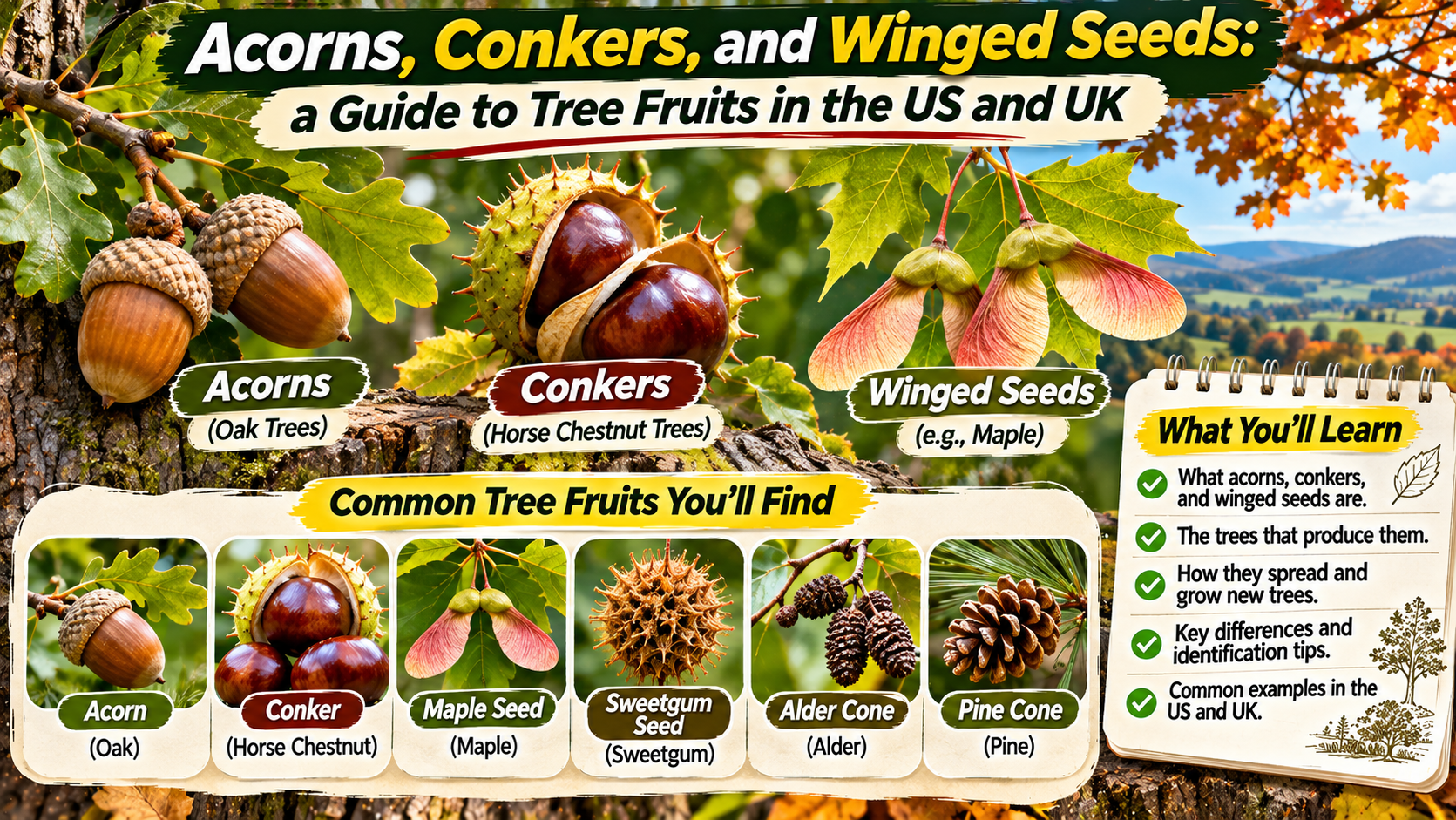
Acorns are nuts, a type of dry fruit.
Maple helicopters are winged fruits called samaras.
Some trees produce fleshy fruits, while others develop capsules, pods, or hard shells.
Not every seed-bearing structure is a botanical fruit. For example, pine cones belong to conifers, which do not produce true fruits.
Recognizing these differences helps explain why tree fruits have such varied appearances.
BOTANICAL FIELD NOTE
A Fruit Protects or Helps Disperse Seeds, but a Seed Is Not Always a Fruit.
For example, the shiny conker is a seed found inside a horse chestnut fruit, while an acorn is itself a dry fruit containing a seed.
1. Acorns: The Fruits of Oak Trees
Acorns are among the most recognizable tree fruits in both the US and UK.
They are produced by oak trees belonging to the genus Quercus.
Most acorns have a rounded or elongated nut attached to a small, cup-shaped structure.
This cup, called a cupule, is often covered with tiny scales.
Acorn size, shape, and cup characteristics vary among oak species.
In Britain, the English oak and sessile oak are familiar native species.
In the United States, white oaks, red oaks, and many other oak species produce acorns with distinctive features.
Some oak species produce mature acorns within one growing season, while others require two seasons.
Acorns provide an important food source for wildlife, including squirrels, deer, jays, and other birds and mammals.
How to Identify an Acorn
- Look for a smooth, hard nut with a cup-shaped cap.
- Notice whether the acorn is rounded, oval, or elongated.
- Examine how much of the nut is covered by the cup.
- Check nearby oak leaves and bark for additional identification clues.
Because different oak species can produce similar acorns, fruit appearance alone may not identify the exact species.
2. Conkers: The Shiny Seeds of Horse Chestnut Trees
Conkers are particularly familiar in Britain, where collecting them has long been associated with autumn.
They come from the horse chestnut tree, Aesculus hippocastanum.
The tree produces green capsules that are often covered with relatively widely spaced spines.
When mature, the capsules split open and release one or more glossy brown seeds.
These seeds are called conkers.
Horse chestnut trees are also planted in parts of the United States, although several native American buckeye species belong to the same genus.
Conkers are recognizable by their polished reddish-brown surface and pale attachment scar.
They should not be confused with edible sweet chestnuts.
IMPORTANT SAFETY NOTE
Horse chestnut conkers are not edible.
They contain toxic compounds and should not be eaten by people or offered to pets. Never assume that a shiny brown seed is safe to consume simply because it resembles an edible chestnut.
3. Sweet Chestnuts: Similar Name, Different Tree
Sweet chestnuts come from trees in the genus Castanea.
In Britain, the sweet chestnut tree, Castanea sativa, is a familiar introduced species.
In North America, the American chestnut, Castanea dentata, was historically a major forest tree before chestnut blight devastated its populations.
Sweet chestnuts develop inside densely spiny protective coverings called burs.
These coverings look noticeably different from the more sparsely spined capsules of horse chestnut.
The nuts themselves often have a pointed tip and a somewhat flattened side.
Unlike horse chestnut conkers, chestnuts from correctly identified edible Castanea species can be used as food.
However, foraging requires confident identification and appropriate food preparation.
4. Maple Helicopters: Paired Winged Fruits
One of the most entertaining tree fruits to watch is the maple samara.
Many maple trees produce paired winged fruits that resemble miniature helicopter blades.
When they fall, the wings help them rotate or glide through the air.
This slows their descent and may allow wind to carry them away from the parent tree.
In the United States, red maple, sugar maple, silver maple, and other maple species produce characteristic samaras.
In the UK, field maple and sycamore maple are familiar examples.
Although the name sycamore is commonly used for Acer pseudoplatanus in Britain, American sycamore refers to a different tree, Platanus occidentalis.
That difference in common names is important when comparing US and UK tree guides.
How to Recognize Maple Samaras
- Look for two winged fruits joined near their bases.
- Observe the angle between the wings.
- Compare the size and shape of the wings.
- Check the leaves, which are often palmately lobed.
The angle and shape of the wings can help distinguish maple species, although several features should be used together.
5. Ash Keys: Single-Winged Fruits
Ash trees produce another recognizable type of winged fruit.
These fruits are often called keys, especially in Britain.
Unlike the paired samaras of maples, ash samaras generally have a single elongated wing.
They frequently hang in clusters from the branches.
As the fruits mature, they turn brown and may remain attached well into colder months.
European ash, Fraxinus excelsior, is familiar in the UK.
In the United States, species such as white ash and green ash also produce winged fruits.
Ash identification can be supported by examining the tree’s opposite branching pattern and compound leaves.
These features are useful when fallen seeds from different nearby trees become mixed together.
6. Beech Nuts: Small Treasures in Prickly Husks
Beech trees produce small triangular nuts enclosed in protective husks.
European beech, Fagus sylvatica, is widespread in Britain.
American beech, Fagus grandifolia, grows in eastern North America.
Beech fruits typically develop inside husks with soft-looking prickles.
When mature, the husks open to reveal the nuts.
Beech nuts are an important food resource for several woodland animals.
They also provide a useful identification clue beneath mature beech trees.
The trees themselves often have smooth gray bark, although bark appearance may change with age or damage.
7. Sweetgum Balls: Spiky Fruits Common in America
American sweetgum, Liquidambar styraciflua, produces distinctive round fruit clusters.
These woody structures are covered with pointed projections and are often described as spiky balls.
Each ball contains numerous small capsules that release seeds as they mature.
Sweetgum is native to parts of the eastern and southeastern United States.
It is also planted as an ornamental tree in some other regions, including Britain.
The tree’s star-shaped leaves can resemble maple leaves, but its spiky fruit clusters provide a useful distinction.
Fallen sweetgum balls may remain visible beneath trees long after their seeds have been released.
8. Plane Tree Seed Balls
Plane trees produce rounded clusters of small fruits that may hang from branches into winter.
In the United States, the American sycamore is a member of the plane tree genus Platanus.
In Britain, the London plane is a familiar street and park tree.
Their fruits are formed from many small individual fruits grouped into spherical heads.
As the heads break apart, the small fruits are released.
Plane trees can often be recognized by their large lobed leaves and distinctive bark, which may peel in patches.
Because their fruit clusters can resemble other round seed structures from a distance, examine the texture and nearby leaves before identifying them.
Quick Identification Chart: Common Tree Fruits
| Tree | Fruit or Seed | Key Feature | Where You May See It |
|---|---|---|---|
| Oak | Acorn | Nut with a cup-shaped cap | US and UK |
| Horse chestnut | Conker | Glossy seed inside spiny capsule | Common in UK; planted in US |
| Sweet chestnut | Chestnut | Nut inside densely spiny bur | UK and parts of US |
| Maple | Paired samaras | Helicopter-like wings | US and UK |
| Ash | Keys | Single elongated wings | US and UK |
| Beech | Beech nuts | Small triangular nuts | US and UK |
| Sweetgum | Spiky fruit balls | Hard spherical clusters | Especially common in US |
| Plane tree | Round fruit heads | Hanging spherical clusters | US and UK |
How Trees Spread Their Seeds
The different shapes of tree fruits are closely connected to seed dispersal.
Dispersal helps seeds reach places where they may have a better chance of germinating.
Different tree species use different strategies.
SEED DISPERSAL / FOUR COMMON STRATEGIES
Maple and ash samaras use wings that help them travel through the air.
Squirrels and birds may carry or bury acorns, sometimes leaving seeds in places where they can germinate.
Heavy fruits and nuts fall from branches and may roll or bounce away from the parent tree.
Some trees attract animals that eat fruit and later disperse viable seeds elsewhere.
When Is the Best Time to Look for Tree Fruits?
Autumn is an excellent season for identifying many tree fruits in the United States and United Kingdom.
Acorns, conkers, chestnuts, and beech nuts are often noticeable as they mature and fall.
However, not every species releases its seeds in autumn.
Some maples, including red and silver maples in North America, commonly release mature samaras during spring or early summer.
Other maples release their fruits later in the year.
Ash keys and plane tree fruit heads may remain on branches into winter.
The timing also depends on local climate, weather, species, and seasonal conditions.
For reliable identification, it helps to observe the same trees throughout the year rather than relying on one visit.
How to Identify Trees from Fallen Fruits
Finding a fruit on the ground is a useful starting point, but it does not always prove which tree produced it.
Wind, animals, and sloping terrain can move fruits away from their original location.
Begin by examining the fruit’s overall shape.
Look for wings, cups, husks, spikes, or clusters.
Then compare nearby trees using their leaves, bark, twigs, and branching patterns.
Taking photographs of both the fruit and the tree can help with later identification.
A regional field guide is especially useful because different species occur in different parts of the US and UK.
Whenever possible, use several characteristics before deciding on a species.
A Simple Woodland Observation Activity
Tree fruit identification can be an enjoyable activity for families, students, and beginner naturalists.
Choose a park, woodland path, or neighborhood with several different tree species.
Carry a notebook or use a phone to record observations.
For each fruit you find, write down its shape, color, approximate size, and texture.
Look upward to identify possible parent trees.
Photograph the leaves and bark whenever practical.
Compare your observations with a reliable tree identification guide.
Try revisiting the same location in another season to see how the trees change.
Observing fruits over time helps build a more complete understanding of tree life cycles.
Collecting Tree Fruits Responsibly
Fallen fruits and seeds are part of the woodland ecosystem.
Many provide food for wildlife or eventually develop into new plants.
Collecting a few common fallen specimens may be acceptable in some places, but rules vary between parks, nature reserves, and private land.
Always follow local regulations and obtain permission where required.
Avoid collecting from protected habitats or damaging branches to reach fruits.
Do not eat unidentified nuts or seeds.
Some tree fruits, including horse chestnut conkers, can be harmful if swallowed.
Photographing specimens is often the best way to create a useful identification record without disturbing the environment.
Frequently Asked Questions
What is the difference between an acorn and a conker?
An acorn is the nut-like fruit of an oak tree. A conker is the large glossy seed of a horse chestnut tree, released from a spiny capsule.
Are conkers edible?
No. Horse chestnut conkers contain toxic compounds and should not be eaten.
Which trees produce helicopter seeds?
Maple trees produce paired winged fruits commonly called helicopters. Ash trees also produce winged fruits, usually with a single wing.
Are sycamore trees the same in the US and UK?
No. The British sycamore is a maple, Acer pseudoplatanus, while the American sycamore is a plane tree, Platanus occidentalis.
What tree produces spiky brown balls?
American sweetgum produces distinctive spiky woody fruit clusters, although other trees can also produce rounded seed structures.
When do acorns and conkers fall?
They commonly mature and fall during autumn, although exact timing depends on species, location, and seasonal weather.
Can you identify a tree from its fruit alone?
Sometimes a fruit provides a strong clue, but using leaves, bark, buds, and other characteristics usually produces a more reliable identification.
Final Thoughts
Acorns, conkers, winged seeds, and other tree fruits provide a fascinating introduction to woodland identification.
Each structure reflects a different reproductive strategy.
Oak trees produce acorns that may be carried and buried by animals.
Horse chestnuts release glossy conkers from protective capsules.
Maples and ashes use winged fruits to take advantage of the wind.
Beech trees, sweetgums, and plane trees produce other distinctive structures that help observers recognize them.
Although tree species vary between the United States and United Kingdom, the basic principles of fruit identification remain the same.
By examining shape, texture, season, and nearby tree features, anyone can begin to recognize the natural objects scattered across woodland floors.
The next time you walk beneath a canopy of trees, look down as well as up.
The fruits beneath your feet may reveal more about the surrounding woodland than you expect.