BOTANICAL FIELD JOURNAL / TREE IDENTIFICATION
Two Familiar Oaks, Two Very Different Tree Profiles
Learn how English oak and northern red oak differ in leaf shape, bark, acorns, growth patterns, native range, and ecological importance.
Oak trees are among the most recognizable hardwood trees in temperate forests, parks, and residential landscapes.
They are valued for their shade, timber, wildlife benefits, and long-standing cultural significance.
However, the name “oak” includes hundreds of species, and even familiar oaks can differ considerably in appearance and biology.
Two well-known examples are the English oak (*Quercus robur*) and the northern red oak (*Quercus rubra*).
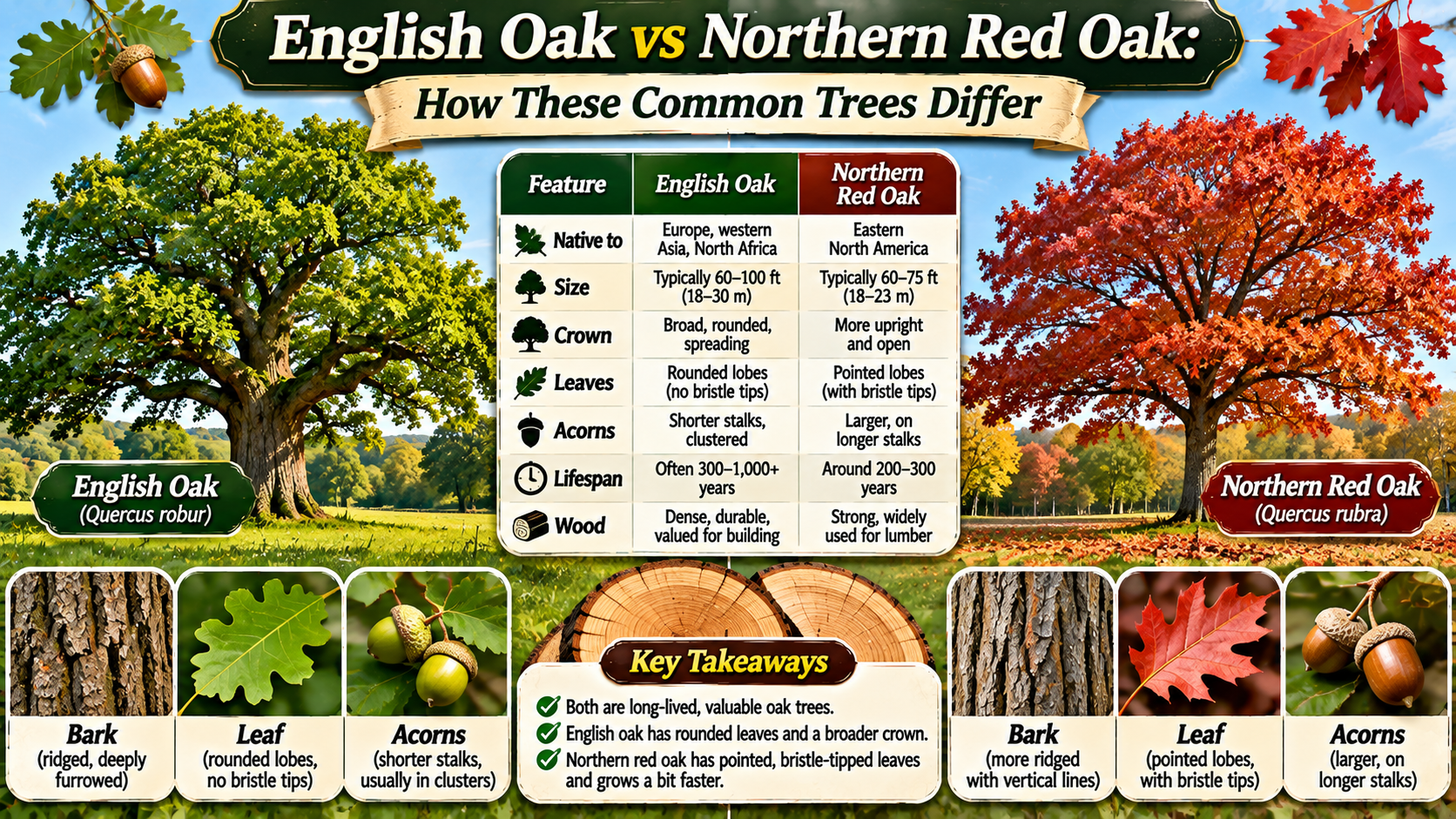
English oak is native to much of Europe and parts of western Asia. Northern red oak is native to eastern North America.
Both are deciduous hardwood trees that produce acorns, but they belong to different major oak groups and show important differences in leaf shape, bark, acorn development, and growth characteristics.
Understanding these features can help homeowners, gardeners, students, and nature enthusiasts identify the trees more confidently.
English Oak: A Classic European Woodland Tree
English oak, scientifically known as *Quercus robur*, is one of Europe’s most familiar native trees.
It grows in woodlands, parklands, agricultural landscapes, and other suitable environments.
Mature English oaks can develop broad crowns and substantial trunks.
Older specimens often have large, spreading branches that create a distinctive silhouette.
The species is associated with the white oak group, which includes oaks with several shared botanical characteristics.
English oak has rounded leaf lobes and acorns that typically mature in a single growing season.
Its long history in European landscapes has also made it important in traditional woodland management, timber production, and cultural heritage.
Northern Red Oak: A Major North American Hardwood
Northern red oak, scientifically known as *Quercus rubra*, is native to eastern North America.
It occurs in many deciduous forests and is also widely planted as a shade and ornamental tree.
The species belongs to the red oak group.
Its leaves typically have pointed lobes ending in small bristle-like tips.
Northern red oak often develops a relatively straight trunk in forest conditions, although open-grown trees can form broad crowns.
It is valued for its timber and its ability to provide food and habitat for wildlife.
Compared with English oak, northern red oak often shows more striking red or reddish-brown autumn foliage under suitable conditions.
Leaf Shape: The Easiest Way to Tell Them Apart
Leaf shape is one of the most useful identification features when comparing these two oak species.
English oak leaves usually have rounded lobes without bristle tips.
The leaves often have relatively short stalks, called petioles.
Small ear-like lobes may occur near the leaf base.
Northern red oak leaves look noticeably different.
They generally have pointed lobes with tiny bristle tips.
The spaces between the lobes, called sinuses, are often deeper and more angular.
Northern red oak leaves also typically have longer petioles than English oak leaves.
Leaf size varies with growing conditions, tree age, and position within the canopy, so shape is generally more useful than size alone.
LEAF PROFILE 01
English Oak
Shape: Rounded lobes
Tips: No bristle tips
Leaf stalk: Usually short
Leaf base: Often has small ear-like lobes
LEAF PROFILE 02
Northern Red Oak
Shape: Pointed lobes
Tips: Small bristles
Leaf stalk: Usually longer
Leaf base: Generally lacks the distinctive ear-like lobes
Bark Differences: What to Look for on the Trunk
Bark can provide additional identification clues, particularly when leaves are absent.
Young English oak trees often have relatively smooth bark.
As they mature, the bark becomes thick, rough, and deeply fissured.
Older trunks may show irregular ridges and furrows.
Northern red oak bark changes with age as well.
Young trees often have relatively smooth, grayish bark.
On mature trees, the bark commonly develops long, shallow ridges.
Some northern red oaks show pale vertical streaks along these ridges, a feature sometimes described as resembling ski tracks.
However, bark appearance varies with age and growing conditions.
For reliable identification, bark should be considered alongside leaves, buds, and acorns.
Acorns: Size, Shape, and Maturity
Both species produce acorns, but their acorn characteristics differ.
English oak acorns are often elongated and may occur on relatively long stalks.
The species name *robur* does not refer to the stalk, but the long acorn stalk is a useful field characteristic.
English oak acorns generally mature during the same growing season in which pollination occurs.
Northern red oak acorns are typically more rounded or broadly oval.
Their caps are relatively shallow and often cover only a limited portion of the nut.
Northern red oak acorns generally require two growing seasons to mature.
This difference reflects the broader distinction between white oak and red oak groups.
BOTANICAL NOTE / ACORN DEVELOPMENT
English Oak Acorns Usually Mature in One Season. Northern Red Oak Acorns Usually Take Two.
This is one of the most useful biological differences between the two species and their respective oak groups.
Growth Rate and Mature Size
Both English oak and northern red oak can become large trees.
However, growth rates and mature dimensions depend strongly on climate, soil, available space, and competition.
Northern red oak is often regarded as a relatively fast-growing oak under favorable conditions.
English oak may grow more slowly in some settings, particularly as it matures.
Open-grown English oaks can develop broad crowns with large spreading branches.
Northern red oaks growing in forests often develop taller, straighter trunks as they compete for sunlight.
These tendencies are not absolute.
Tree form changes substantially with growing conditions, and individuals of either species can develop broad crowns in open landscapes.
Native Range and Preferred Growing Conditions
English oak is native to much of Europe and parts of western Asia.
It is commonly associated with temperate climates and can grow in a variety of suitable soils.
It often performs well where adequate moisture is available, although prolonged waterlogging and other stresses can affect growth.
Northern red oak is native to eastern North America.
It grows in a range of forest environments and often performs well in deep, well-drained soils.
Soil acidity can influence northern red oak performance, and it generally favors acidic to moderately acidic conditions.
Both species have been planted beyond their native ranges.
However, planting suitability depends on local climate, soil conditions, available space, and ecological considerations.
Autumn Color: Which Oak Is More Colorful?
Autumn foliage can help distinguish the two species, although color is influenced by weather and growing conditions.
English oak leaves often turn yellow-brown or brown before falling.
Some leaves may remain attached to younger trees during winter.
Northern red oak is well known for its autumn colors.
Its leaves may turn red, reddish-brown, orange-red, or brown depending on environmental conditions.
Cool nights, sunlight, and seasonal weather patterns can influence the intensity of red pigmentation.
Because foliage color varies, it should not be used as the only identification feature.
Wildlife Value and Ecological Importance
Oak trees support many forms of wildlife.
Their leaves, bark, branches, and acorns provide resources for insects, birds, and mammals.
English oak is particularly important within ecosystems where it is native.
It supports numerous associated organisms, including insects and other species adapted to European oak woodlands.
Northern red oak also provides valuable habitat and food resources in North American forests.
Its acorns are eaten by wildlife such as squirrels, deer, and various birds.
Oak canopies provide shade and shelter, while older trees may develop cavities used by nesting animals.
The ecological value of either species depends partly on its location.
Native trees generally have stronger established relationships with local wildlife communities than trees introduced from distant regions.
English Oak vs Northern Red Oak: Comparison Table
| Feature | English Oak | Northern Red Oak |
|---|---|---|
| Scientific Name | Quercus robur | Quercus rubra |
| Oak Group | White oak group | Red oak group |
| Native Range | Europe and western Asia | Eastern North America |
| Leaf Lobes | Rounded | Pointed with bristle tips |
| Acorn Maturity | Usually one season | Usually two seasons |
| Autumn Color | Often yellow-brown to brown | Often red to reddish-brown |
| Typical Mature Bark | Deeply fissured | Long ridges, sometimes with pale streaks |
How to Identify These Oaks in the Field
When identifying an unfamiliar oak tree, examine several features rather than relying on a single characteristic.
Start with the leaves.
Rounded lobes without bristles suggest English oak or another white oak species.
Pointed lobes with bristle tips suggest northern red oak or another member of the red oak group.
Next, examine the acorns if they are present.
Look at their shape, cap, and stalk arrangement.
Then observe the bark and overall growth form.
Finally, consider the tree’s geographic location and surrounding habitat.
Because several oak species have similar features, regional identification guides may be needed to confirm a specimen.
TREE IDENTIFICATION / FIELD CHECKLIST
Rounded lobes suggest English oak; pointed bristle-tipped lobes suggest northern red oak.
English oak usually has shorter leaf stalks than northern red oak.
Compare acorn shape, cap depth, and the presence of long stalks.
Look for deep irregular fissures or long vertical ridges.
Native range and local planting history can help narrow the identification.
Which Oak Is Better for a Garden or Landscape?
Both species can make impressive landscape trees where growing conditions are suitable.
However, mature oaks require substantial space.
English oak may be appropriate for large parks, open landscapes, and settings where a broad mature canopy is desirable.
Northern red oak is frequently planted as a shade tree in suitable North American landscapes.
Its autumn color can also be an attractive feature.
Before planting either species, consider the mature crown size, soil drainage, local climate, and proximity to buildings or infrastructure.
In areas outside their native ranges, potential ecological effects should also be considered.
Local native tree species may offer better support for regional biodiversity.
Frequently Asked Questions
What is the main difference between English oak and northern red oak?
English oak typically has rounded leaf lobes, while northern red oak has pointed lobes with small bristle tips.
Are English oak and northern red oak the same species?
No. English oak is Quercus robur, while northern red oak is Quercus rubra.
Which oak grows faster?
Northern red oak is often considered relatively fast-growing under favorable conditions, although growth rates vary with climate, soil, and site conditions.
Which oak has red autumn leaves?
Northern red oak is more commonly associated with red or reddish-brown autumn foliage.
How long do their acorns take to mature?
English oak acorns usually mature in one growing season, while northern red oak acorns generally take two growing seasons.
Can both oak species grow in North America?
Yes. Northern red oak is native to eastern North America, while English oak is also planted in suitable locations outside its native range.
Are both species useful for wildlife?
Yes. Both can provide food and habitat, although their ecological relationships differ according to geographic location and native status.
Final Thoughts
English oak and northern red oak are both impressive deciduous hardwood trees, but they have distinctive botanical characteristics.
English oak is recognized by its rounded leaf lobes, often short leaf stalks, and acorns that usually mature within one growing season.
Northern red oak typically has pointed bristle-tipped leaves, often striking autumn colors, and acorns that generally require two growing seasons to develop.
Bark patterns, growth forms, and native ranges provide additional identification clues.
By examining these features together, tree enthusiasts can distinguish the two species more confidently and appreciate their different roles in temperate ecosystems.