🐝 Ecological Monograph: Forest Pollination Dynamics
An in-depth scientific study of pollination syndromes in temperate forest ecosystems. Details aerodynamic fluid physics of wind pollination (anemophily), insect-plant mutualisms (entomophily), pollen grain micro-morphology, pollen-ovule ratios, and climate change phenological mismatches.
Pollination—the physical transfer of male gametophytes (pollen grains) from the anther or microsporangium to the receptive stigma or ovular micropyle—is the foundational biological event that drives genetic recombination and sexual reproduction in seed-bearing forest trees. In terrestrial forest ecosystems, the evolutionary arms race for pollination success has produced two dominant, contrasting ecological strategies: anemophily (pollination mediated by abiotic atmospheric air currents) and entomophily (biotic pollination mediated by foraging insects, alongside minor zoophilic vectors including birds and bats).
The distribution of these two pollination syndromes is not random; it adheres strictly to geographic latitude, forest structural strata, and canopy microclimates. In closed-canopy tropical rainforests, where high humidity dampens pollen and dense foliage baffles wind flow, over 95 percent of canopy trees rely upon animal pollinators. In stark contrast, across the vast temperate deciduous and boreal conifer biomes of the Northern Hemisphere, anemophily reigns supreme, commanding over 80 to 90 percent of canopy-dominant tree species including oaks, birches, pines, and spruces. Understanding the biophysical mechanics of wind pollination, the co-evolutionary floral adaptations of insect-pollinated trees, and the catastrophic threat of climate-induced phenological decoupling is paramount for modern conservation arborists and forest ecologists.
1. Anemophily: The Aerodynamic Biophysics of Wind Pollination
Wind pollination is frequently mischaracterized as a primitive, wasteful, random lottery where trees simply blast clouds of pollen into the air and hope for the best. Modern aerodynamic fluid dynamic research—utilizing high-speed digital imaging and wind tunnel simulations—has revealed that anemophily is a highly sophisticated, mathematically optimized physical system governed by boundary layer physics and vortex shedding.
For a tree to successfully execute wind pollination, its floral structures and pollen grains must satisfy several rigorous physical parameters:
- Pollen Grain Architecture: Anemophilous pollen grains are small (typically 18 to 35 micrometers in diameter), spherical or bisaccate, exceptionally lightweight, and completely dry. Unlike insect pollen, which is coated in sticky, lipid-rich pollenkitt that cements grains into heavy clumps, wind-pollinated grains possess smooth, non-sticky exines that disperse instantly as single, discrete particles.
- Pollen Settling Velocity: Biophysicists calculate the settling velocity (Vs) of pollen using Stokes’ Law. Anemophilous tree pollen exhibits terminal descent velocities between 1.5 and 4.0 centimeters per second, allowing horizontal atmospheric turbulence to carry grains for miles before settling.
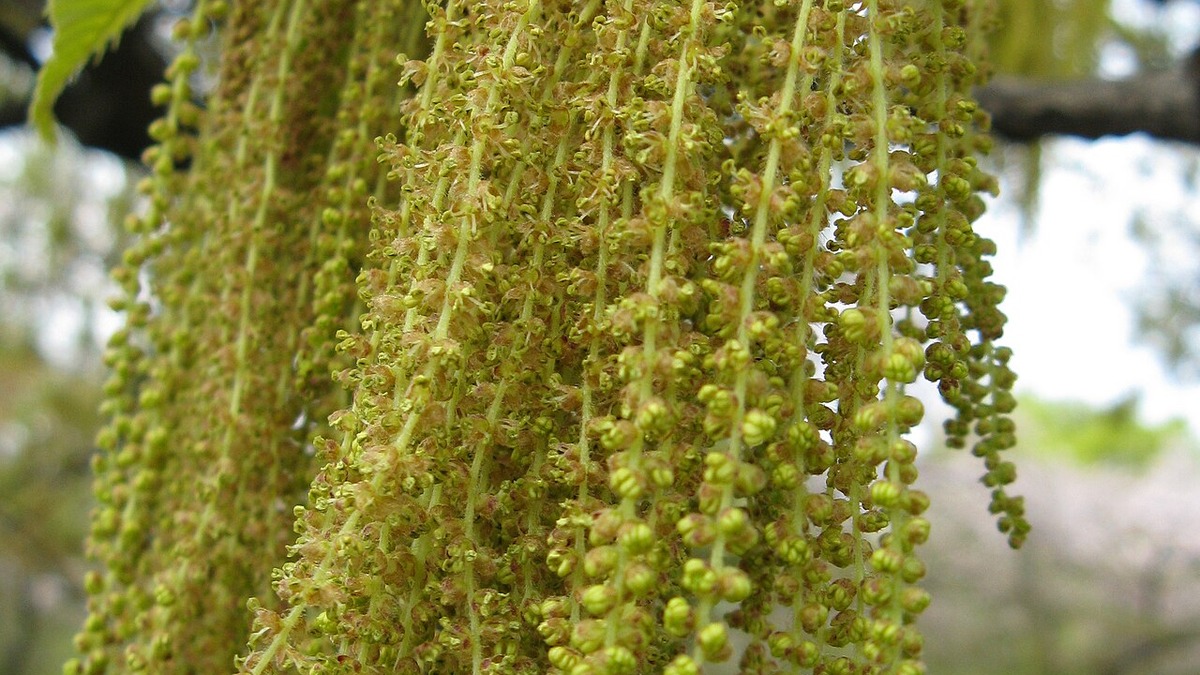
- Floral Reduction and Exsertion: Wind-pollinated flowers have eliminated energy-expensive petals, sepals, and nectaries. Stamens are supported on long, slender, flexible filaments that sway violently in the breeze, shaking anthers loose, or are packed into pendulous, swaying catkins (aments) that act as mechanical dust shakers.
- Enlarged Receptive Stigmatic Traps: Pistillate flowers feature disproportionately massive, feathery, branched, or papillose stigmas that project prominently into moving air currents. In species like Hazelnut (Corylus) and Oak (Quercus), these extended stigmatic branches dramatically amplify the effective surface area for particle capture.
Most remarkably, aerodynamicists have discovered that the geometric shape of female conifer cones and flower-subtending bracts actively alters local airflow. As wind encounters a female pine conelet, the geometry of the ovuliferous scales generates microscopic trailing aerodynamic vortices that curl back toward the cone axis, spiraling airborne pollen grains directly into the sheltered micropylar openings of the ovules with stunning mechanical efficiency.
| Pollination Syndrome | Vector | Floral Architecture | Perianth (Petals) | Pollen Characteristics | Pollen-to-Ovule (P/O) Ratio | Representative Tree Taxa |
|---|---|---|---|---|---|---|
| Anemophily | Atmospheric Wind Currents | Apetalous, pendulous catkins / cones | Absent, vestigial, or reduced | Small (18-35 µm), smooth, dry, bisaccate | Extremely High (100,000 to 1,000,000 : 1) | Quercus, Betula, Pinus, Fagus, Fraxinus |
| Entomophily (Generalist) | Flies, Beetles, Solitary Bees | Open dish-shaped or radial blossoms | White, yellow, or greenish petals | Sticky, rough exine, coated in pollenkitt | Moderate (1,000 to 5,000 : 1) | Prunus serotina, Sorbus, Crataegus, Malus |
| Entomophily (Specialist) | Bumblebees, Lepidopterans | Complex bilateral zygomorphic flowers | Vibrant colors, banner/keel petals, nectar guides | Heavily ornamented, sticky pollen clumps | Low to Moderate (500 to 2,000 : 1) | Cercis canadensis, Robinia pseudoacacia |
| Cantharophily (Beetles) | Primitive Floral Beetles | Large, fleshy solitary cup blossoms | Fleshy tepals, strong fruit/ferment odors | Abundant protein-rich pollen food source | Moderate (2,000 to 10,000 : 1) | Magnolia virginiana, Asimina triloba (Pawpaw) |
| Melittophily (Bees) | Social & Solitary Bees | Pendant clusters or tubular flowers | Fragrant, abundant sucrose/glucose nectar | Moderate size, protein-dense | Moderate (1,000 to 3,000 : 1) | Tilia americana (Basswood), Acer saccharum |
2. Entomophily: Floral Mutualisms and Pollinator Rewards
While anemophily dominates northern canopies, insect pollination (entomophily) is critical for diverse understory trees, early-successional pioneers, and iconic forest giants such as Basswood, Tuliptree, and Black Cherry. In entomophilous mutualisms, trees trade metabolic energy (carbohydrate nectar and protein-rich pollen) in exchange for targeted, high-efficiency pollen transport directly to conspecific stigmas.
The floral evolutionary adaptations of insect-pollinated trees reflect tight co-evolutionary specializations:
1. Visual Signals and Nectar Guides: In American Basswood (Tilia americana), pale creamy-yellow blossoms hang in cymes subtended by a prominent, pale green strap-like bract that flutters in the wind, catching the eye of foraging insects. Under ultraviolet light, many tree blossoms display hidden UV-absorbent ‘nectar guides’—optical bullseyes that direct foraging bumblebees directly toward the hidden nectary reservoirs at the base of the petals.
2. Olfactory Chemical Signaling: Floral scents are complex volatile cocktails designed to broadcast over long distances through forest canopies. In Black Cherry (Prunus serotina), blossoms release sweet, aromatic benzaldehyde and linalool that attract hundreds of generalist syrphid flies and solitary bees. In the understory Pawpaw (Asimina triloba), blossoms are dark maroon, mimicking rotting carrion in both appearance and smell; they emit foul sulfurous compounds (dimethyl disulfide) that trick carrion flies and sap beetles into pollinating the flowers.
3. Nutritional Economics of Pollen vs. Nectar: Nectar is an aqueous solution composed primarily of sucrose, glucose, and fructose, functioning as high-octane rocket fuel for adult insect flight metabolism. Pollen grains, however, are nutrient-dense nutritional powerhouses containing 15 to 30 percent crude protein, essential amino acids, lipids, and vitamins. Foraging bees consume pollen to feed developing larvae in their hives, inadvertently dusting their bodies with surplus grains that rub off on receptive stigmas as they forage.
3. Pollen-to-Ovule (P/O) Ratios: The Cost of Dispersal Vectors
In evolutionary ecology, the efficiency of a pollination system is measured by its Pollen-to-Ovule (P/O) ratio—the total number of pollen grains produced by a flower or plant divided by the total number of ovules ready for fertilization. This ratio reflects the physical precision of the pollination vector.
Because wind is a diffuse, non-directional vector where 99.999 percent of pollen grains land harmlessly on soil, leaf surfaces, or water bodies without ever encountering a receptive stigma, anemophilous trees must produce astronomical quantities of pollen. In European Birch (Betula pendula) and White Oak (Quercus alba), the P/O ratio routinely reaches 500,000 to 1,000,000 : 1. A single mature pine tree can release up to several billion pollen grains during a two-week anthesis period.
In stark contrast, insect-pollinated trees operate with surgical precision. Because a foraging bumblebee or honeybee travels directly from one cherry or dogwood flower to another of the same species, the likelihood of a pollen grain reaching a target stigma is orders of magnitude higher. Consequently, entomophilous trees produce far less pollen per ovule, with P/O ratios ranging from 1,000 to 5,000 : 1 in generalist cherry blossoms, down to fewer than 500 : 1 in specialized legumes. This dramatic difference demonstrates the fundamental bioenergetic trade-off: wind-pollinated trees invest their carbon into astronomical pollen numbers, while insect-pollinated trees invest their carbon into showy petals, nectar secretions, and floral perfumes.
4. Phenological Decoupling and Climate Change Threats
The delicate orchestration of forest pollination is currently facing unprecedented disruptions from global anthropogenic climate warming. In temperate forest ecosystems, plants and their animal pollinators coordinate their life cycles using different environmental cues:
- Many woody trees initiate spring budburst and flowering based on accumulated thermal heat units (Growing Degree Days, GDD) following winter chilling.
- Many native solitary bees, syrphid flies, and butterflies emerge from winter diapause based on soil temperature thresholds or strict photoperiod (daylength) signals.
As spring atmospheric temperatures warm at accelerating rates, trees are breaking dormancy and flowering earlier in the season—advancing anthesis by 2 to 5 days per decade across North America and Europe. This creates a catastrophic phenomenon known as phenological mismatch (trophic asynchrony):
- Early Flowering Before Pollinator Emergence: Fruit and canopy trees (such as serviceberries, cherries, and dogwoods) bloom during sudden early spring heatwaves before native bees have emerged from their underground nests. By the time pollinators emerge, floral petals have dropped, anthers have dehisced, and flowers remain unfertilized, collapsing fruit set.
- Late Frost Vulnerability: Trees that flower unseasonably early are acutely vulnerable to late spring frost events. When temperatures plunge below freezing, ice crystals rupture the thin-walled cells of receptive stigmas and styles, causing immediate necrosis and aborting the entire annual seed crop.
- Pollen Viability Heat Stress: High ambient temperatures during summer flowering can exceed the thermal tolerance of pollen grains. Research shows that temperatures exceeding 32 degrees Celsius degrade pollen protein enzymes and dry out stigmatic exudates, preventing pollen tube germination and fertilization.
5. Urban Forestry Strategies for Pollinator Conservation
In response to global pollinator declines, municipal arborists and urban foresters are transforming urban canopy planning. Historically, city planners frequently planted exclusively male clones of dioecious trees (such as male clones of Ginkgo, White Ash, and Willow) to avoid messy fruit drop on city sidewalks. This widespread practice flooded urban atmospheres with hyper-abundant airborne pollen—triggering severe human allergic rhinitis and asthma epidemics—while providing zero nectar or pollen resources for declining native insect populations.
Modern arboricultural best practices prioritize biodiverse, pollinator-friendly canopy selections:
- Planting native entomophilous canopy trees—such as American Basswood (Tilia americana), Black Cherry (Prunus serotina), and Tuliptree (Liriodendron)—which provide vital early-season nectar without contributing to airborne allergy loads.
- Integrating early-flowering understory trees—such as Redbud (Cercis canadensis) and Serviceberry (Amelanchier arborea)—which provide essential sustenance for emerging queen bumblebees when ground-layer wildflowers are scarce.
- Preserving dead wood and snags with beetle exit holes, which provide nesting cavities for native solitary cavity-nesting bees (such as leafcutter and mason bees).
By protecting the intricate ecological webs linking forest trees with their atmospheric and animal vectors, arborists and ecologists ensure the enduring sexual regeneration and genetic vitality of our planet’s woodland biomes.
6. Aerobiological Modeling and Public Health Allergology
In modern environmental medicine and public health, the aerobiology of wind-pollinated trees represents an area of intense research. Tree pollen is the leading environmental trigger for seasonal allergic rhinitis (hay fever), allergic conjunctivitis, and severe bronchial asthma epidemics across the globe.
Major allergenic proteins—such as Bet v 1 in Birches (Betula), Que a 1 in Oaks (Quercus), and Fra e 1 in Ashes (Fraxinus)—are low-molecular-weight pathogenesis-related proteins synthesized within the pollen cytoplasm. When dehydrated airborne pollen grains contact moist human respiratory mucous membranes, osmotic hydration causes the grain to burst, discharging these allergenic proteins within milliseconds. The human immune system mistakenly recognizes these proteins as parasitic antigens, triggering IgE antibody cross-linking and massive histamine release from mast cells. Atmospheric aerobiologists deploy volumetric Burkard spore traps on municipal rooftops, coupling daily microscopic pollen counts with meteorological wind-dispersion models to provide early warning forecasts for sensitive human populations.
7. Floral Thermogenesis in Early-Spring Understory Trees
While the vast majority of plants are poikilothermic (taking on the temperature of surrounding ambient air), a select group of primitive woody and herbaceous understory plants possess the extraordinary ability to generate internal heat: floral thermogenesis.
In early spring, when woodland snowpacks remain unmelted, the blossoms of primitive understory trees and shrubs (such as Eastern Skunk Cabbage Symplocarpus foetidus and early Magnolias) utilize alternative oxidase (AOX) enzymes in their mitochondrial electron transport chains. Rather than coupling carbohydrate breakdown to ATP synthesis, these cells bypass ATP synthase, converting metabolic energy directly into pure heat. This biochemical furnace elevates flower temperatures by 5 to 15 degrees Celsius above freezing ambient air, melting surrounding snow, vaporizing volatile foul-smelling carrion odors (amines and indoles) to attract early-emerging pollinating flies, and providing a warm thermal sanctuary that entices shivering pollinators to linger inside the blossom.
8. Nocturnal Pollination Dynamics: Sphingid Hawkmoths and Night Blossoms
While daylight forest pollination is dominated by bees and flies, a specialized nocturnal guild of woodland trees relies upon night-flying insects, predominantly sphingid hawkmoths (Sphingidae) and owlet moths (Noctuidae)—a pollination syndrome termed sphingophily.
Trees adapted to nocturnal moth pollination—such as Sweetbay Magnolia (Magnolia virginiana) and various tropical canopy legumes—exhibit distinct morphological adaptations: blossoms are pure white or pale cream (maximizing optical reflectivity under moonlight and starlight), possess deep tubular floral chambers accessible only by extended hawkmoth proboscises, and produce intense, sweet floral fragrances (heavy in linalool, geraniol, and methyl benzoate) that peak abruptly after sunset. Night-vision infrared camera trapping reveals that hovering hawkmoths can pollinate hundreds of canopy blossoms in a single night flight, mediating long-distance gene flow between isolated forest fragments.