BOTANICAL FIELD JOURNAL · TREE IDENTIFICATION
Three Familiar Trees. Three Different Leaf Stories.
Learn to recognize maple, American sycamore, and sweetgum trees by studying leaf shape, arrangement, edges, bark, and seed structures.
Walking through a park or neighborhood in autumn, you may notice several trees with broad, pointed leaves that look surprisingly similar.
Some have five lobes. Others have three or seven. Their leaves may turn yellow, orange, red, or purple as temperatures change.
At first glance, maple, sycamore, and sweetgum leaves can be difficult to distinguish.
These trees are common in many parts of the United States, and their overlapping leaf shapes often confuse beginner tree enthusiasts.
Fortunately, each has distinctive characteristics.
The easiest way to identify them is to examine leaf arrangement, lobe shape, leaf margins, bark, and the seeds or fruits produced by the tree.
By learning a few reliable clues, you can recognize these trees more confidently during walks, hikes, and backyard observations.
Why Maple, Sycamore, and Sweetgum Leaves Look Similar
All three trees commonly produce broad leaves with several projecting lobes.
A lobe is a distinct extension of the leaf blade separated from neighboring lobes by indentations called sinuses.
Some leaves have shallow sinuses, while others have deep cuts that create a more dramatic star-like shape.
These similarities can make identification challenging, especially when leaves are viewed individually on the ground.
However, the trees belong to different botanical groups.
Maples belong to the genus Acer.
American sycamore belongs to the genus Platanus.
American sweetgum belongs to the genus Liquidambar.
Although their leaves may resemble one another, their growth patterns, reproductive structures, and bark provide useful distinguishing features.
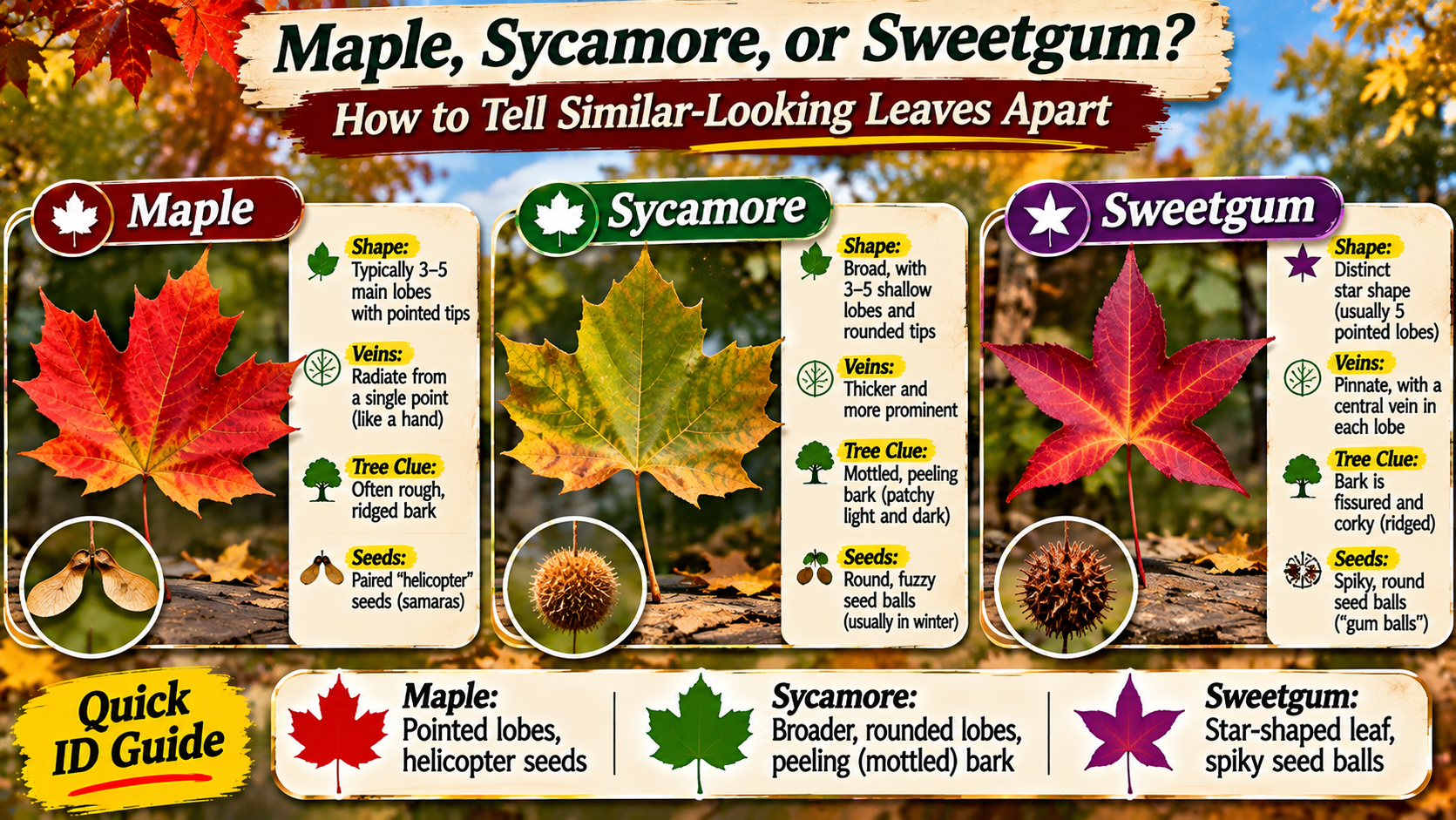
1. Maple Leaves: Look for Opposite Arrangement
Maples are among the most recognizable deciduous trees in North America.
Species such as red maple, sugar maple, and silver maple are widely known for their distinctive foliage and autumn colors.
Many maple species have palmately lobed leaves, meaning the lobes spread outward from a central point near the leaf stalk.
Depending on the species, maple leaves commonly have three to five major lobes.
Some species have smooth-looking margins, while others have noticeable teeth.
One of the most useful identification clues is leaf arrangement.
Maple leaves grow in opposite pairs along the twig.
This means two leaves emerge from approximately the same point on opposite sides of the stem.
That feature helps distinguish maples from American sycamore and sweetgum, which have alternate leaf arrangements.
Other Maple Identification Clues
Maple trees produce paired winged fruits called samaras.
These are often described as helicopter seeds because they spin while falling.
The shape and angle of the paired wings vary among maple species.
Maple bark also differs between species and changes with age.
Young trees may have relatively smooth bark, while older trunks can develop ridges or plates.
Because bark varies, opposite leaf arrangement and paired samaras are often more dependable clues.
SPECIMEN CARD / ACER
Maple
Leaf arrangement: Opposite.
Typical leaf shape: Often three to five lobes, depending on species.
Fruit: Paired winged samaras.
Best identification clue: Opposite leaves combined with characteristic maple fruits.
2. American Sycamore Leaves: Broad Lobes and Distinctive Bark
American sycamore, scientifically known as Platanus occidentalis, is a large deciduous tree native to eastern and central North America.
Its leaves can resemble maple leaves because they are broad and commonly have three to five lobes.
However, sycamore lobes are often relatively broad, with shallower indentations than those of many sweetgum leaves.
Leaf size varies, but American sycamore leaves can become quite large.
The leaves are arranged alternately along the twigs rather than in opposite pairs.
This provides an immediate distinction from maples.
American sycamore is also famous for its unusual bark.
As the tree grows, patches of outer bark peel away, revealing lighter surfaces beneath.
The trunk often develops a mottled pattern of brown, gray, cream, and pale greenish-white.
On mature trees, this patchwork bark can be visible from a considerable distance.
The Round Seed Balls of Sycamore
American sycamore produces rounded fruiting heads that may remain attached to branches during winter.
These structures contain many small, closely packed fruits called achenes.
As the fruiting heads break apart, the individual fruits are released.
The round seed balls are very different from the paired winged fruits of maples.
They also differ from sweetgum’s hard, spiky fruiting structures.
SPECIMEN CARD / PLATANUS OCCIDENTALIS
American Sycamore
Leaf arrangement: Alternate.
Typical leaf shape: Broad, usually three to five lobes.
Fruit: Rounded seed-bearing heads.
Best identification clue: Distinctive peeling, mottled bark.
3. Sweetgum Leaves: A Distinctive Star Shape
American sweetgum, Liquidambar styraciflua, is another deciduous tree native to parts of eastern North America.
It is especially recognizable for its glossy, star-shaped leaves.
Sweetgum leaves commonly have five pointed lobes, although some may have more or fewer.
The sinuses between the lobes are often relatively deep, giving the leaf a sharply defined outline.
Leaf margins are typically finely toothed.
Like American sycamore, sweetgum has alternate leaves.
Therefore, leaf arrangement alone cannot reliably distinguish these two trees.
However, sweetgum leaves often appear more symmetrical and sharply star-shaped than the broad, irregularly lobed leaves of American sycamore.
Sweetgum trees are also well known for their brilliant autumn colors.
Depending on conditions, leaves may turn yellow, orange, red, burgundy, or purple.
Sweetgum’s Spiky Seed Balls
One of the most distinctive sweetgum features is its hard, spherical fruiting structure covered with pointed projections.
These spiky balls often fall to the ground beneath the tree.
They are very different from the smoother-looking, fuzzy fruiting heads of American sycamore.
When leaves are difficult to distinguish, examining fallen fruit can provide a strong identification clue.
SPECIMEN CARD / LIQUIDAMBAR STYRACIFLUA
American Sweetgum
Leaf arrangement: Alternate.
Typical leaf shape: Sharply pointed, often five-lobed star shape.
Fruit: Hard, spiky spherical structures.
Best identification clue: Star-shaped leaves combined with spiky seed balls.
The Most Important Difference: Opposite vs. Alternate Leaves
Leaf arrangement is one of the quickest ways to narrow down a tree’s identity.
In opposite leaf arrangement, two leaves emerge from the same node on opposite sides of the twig.
In alternate leaf arrangement, leaves emerge individually at different points along the stem.
Maples have opposite leaves.
American sycamore and sweetgum have alternate leaves.
This means that checking the twig can immediately separate a maple from the other two trees.
However, always examine several nodes rather than relying on one damaged or incomplete branch.
FIELD IDENTIFICATION SHORTCUT
Opposite Leaves? Think Maple First.
If the leaves are alternate, compare leaf shape, bark, and fruiting structures to distinguish American sycamore from sweetgum.
Maple vs. Sycamore vs. Sweetgum: Comparison Table
| Feature | Maple | American Sycamore | Sweetgum |
|---|---|---|---|
| Leaf arrangement | Opposite | Alternate | Alternate |
| Typical lobes | Often 3–5 | Usually 3–5 | Often 5 |
| Leaf shape | Palmately lobed; varies by species | Broad, relatively shallow lobes | Sharp star shape |
| Leaf edges | Smooth or toothed | Often coarsely toothed | Finely toothed |
| Fruit | Paired winged samaras | Rounded fruiting heads | Spiky seed balls |
| Bark clue | Varies by species | Mottled, peeling bark | Often deeply furrowed with age |
How to Identify These Trees in Five Steps
A consistent observation process makes tree identification easier.
Begin with the leaves, then check the twigs, trunk, and fallen fruits.
BOTANICAL FIELD JOURNAL / IDENTIFICATION ROUTINE
Look for broad lobes, sharp points, and the depth of the sinuses.
Determine whether leaves grow in opposite pairs or alternate along the twig.
Look for sycamore’s distinctive mottled, peeling trunk.
Identify maple samaras, sycamore fruiting heads, or sweetgum’s spiky balls.
Compare several features before making a final identification.
Can Autumn Leaf Color Help Identify the Tree?
Autumn colors can provide useful hints, but they are not reliable enough for identification by themselves.
Maple trees are famous for brilliant fall foliage.
Depending on species and growing conditions, their leaves may turn yellow, orange, red, or combinations of these colors.
Sweetgum can produce similarly dramatic displays, sometimes showing several colors on the same tree.
American sycamore often develops yellowish or brownish autumn foliage, although conditions vary.
Because seasonal color overlaps, the best approach is to combine it with leaf arrangement and fruit characteristics.
A red leaf is not automatically a maple leaf.
Likewise, a yellow leaf does not necessarily indicate sycamore.
What If You Find Only a Fallen Leaf?
Identifying a tree from a single fallen leaf is more difficult because the twig arrangement is no longer visible.
Start by examining the overall outline.
A sharply pointed, symmetrical star shape suggests sweetgum.
A broad leaf with relatively shallow lobes may suggest American sycamore.
A leaf with familiar maple-like lobes may belong to a maple species.
However, these shapes overlap.
Look around for additional leaves from the same tree.
Search for fallen fruits or examine the nearest trunk.
When possible, photograph the leaf beside the bark and a nearby twig.
Multiple observations greatly improve identification confidence.
Common Identification Mistakes
One common mistake is assuming every five-lobed leaf belongs to a maple.
Sweetgum leaves often have five lobes, and American sycamore leaves can also have a similar number.
Another mistake is relying entirely on autumn color.
Seasonal colors vary with species, weather, and environmental conditions.
Some observers also confuse American sycamore with London plane trees, which are widely planted in urban areas and have similar leaves and mottled bark.
London plane trees are related to American sycamore and can require additional clues for confident identification.
Finally, remember that leaves on the same tree may vary in shape and size.
Examine several leaves rather than relying on a single unusual specimen.
Frequently Asked Questions
How can I tell a maple leaf from a sweetgum leaf?
Maples have opposite leaf arrangement and produce paired winged samaras. Sweetgum has alternate leaves and produces hard, spiky seed balls.
What is the easiest way to identify American sycamore?
Look for its distinctive peeling, mottled bark and large, broad leaves arranged alternately along the twigs.
Do sweetgum trees have maple-shaped leaves?
Yes. Sweetgum leaves can resemble maple leaves, but they are often more sharply star-shaped and have alternate arrangement.
Which tree produces spiky balls?
American sweetgum produces hard, spherical fruiting structures covered with pointed projections.
Which tree has helicopter seeds?
Maples produce paired winged fruits called samaras, often nicknamed helicopter seeds.
Can leaf color identify a tree?
Color can provide clues, but leaf arrangement, shape, bark, and fruits are usually more reliable.
Are sycamore and sweetgum the same tree?
No. American sycamore belongs to the genus Platanus, while sweetgum belongs to the genus Liquidambar.
Final Thoughts
Maple, American sycamore, and sweetgum trees may have similar-looking leaves, but several dependable characteristics help distinguish them.
Maples are best recognized by their opposite leaves and paired winged fruits.
American sycamore stands out for its broad leaves, alternate arrangement, rounded fruiting heads, and distinctive peeling bark.
Sweetgum is known for its sharply star-shaped leaves and hard, spiky seed balls.
By examining multiple clues, beginners can move beyond simple leaf-shape comparisons and develop more reliable tree identification skills.
The next time you encounter a fallen leaf in a park or along a trail, take a moment to examine the surrounding tree.
Its branches, bark, and fruits may reveal the answer.