WINTER WOODLAND · TREE IDENTIFICATION FIELD GUIDE
Reading the Forest After the Leaves Have Fallen
Learn to recognize familiar trees through bark textures, winter buds, twig arrangements, and the distinctive shapes of bare branches.
Winter transforms the appearance of deciduous woodlands.
Leaves disappear, branches become exposed, and familiar trees can suddenly seem difficult to recognize.
However, the absence of foliage also reveals identification features that are easy to overlook during warmer months.
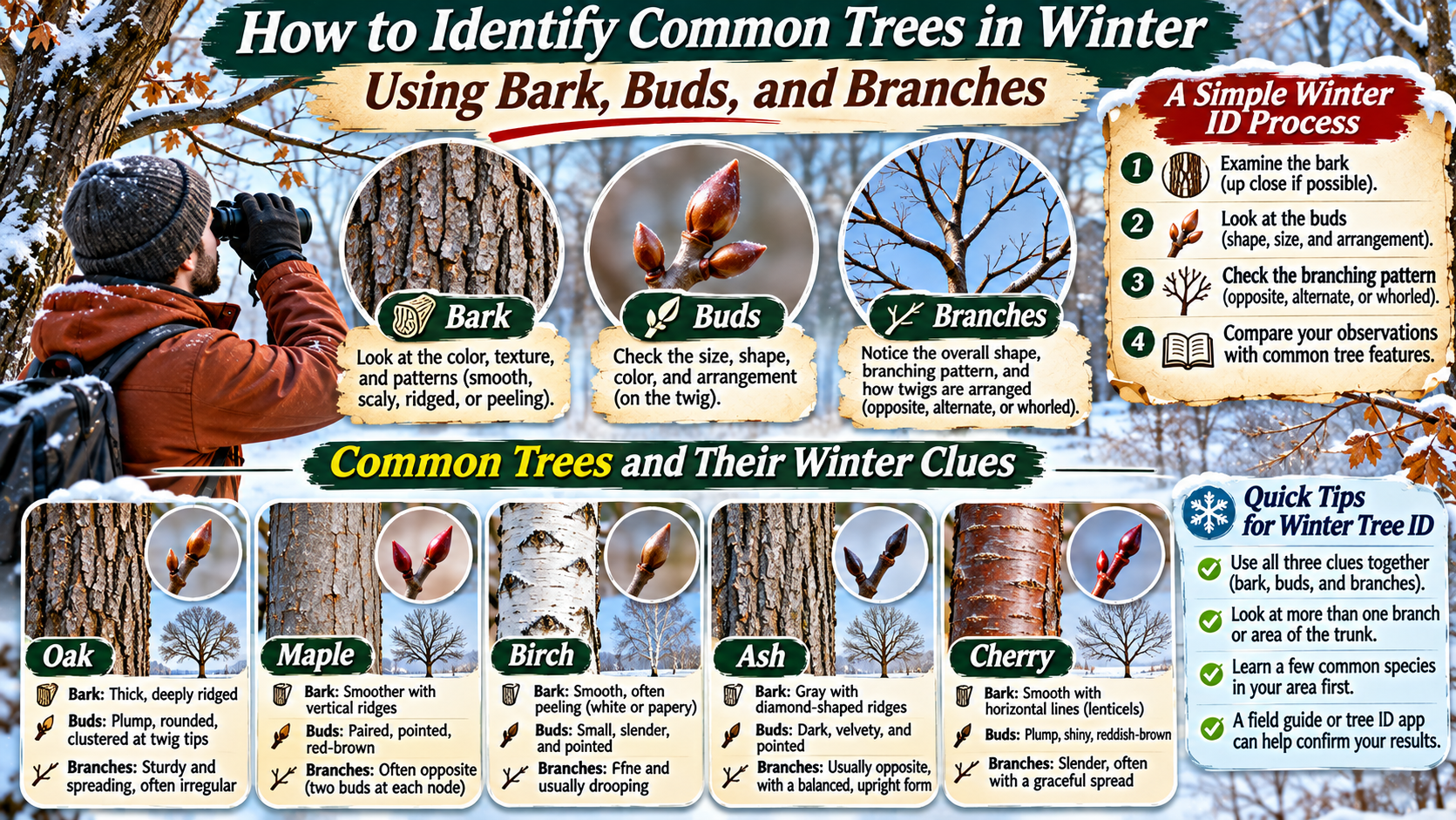
Bark patterns, buds, twigs, and overall branch structure provide valuable clues about tree identity.
With practice, observers can distinguish many common species without relying on leaves, flowers, or fruit.
This skill is useful for nature walks, woodland surveys, backyard observation, and seasonal wildlife studies.
The most reliable approach is to examine several characteristics together rather than identifying a tree from a single feature.
Why Winter Is a Good Season for Tree Identification
At first glance, winter may seem like the most difficult time to identify trees.
Many deciduous species have lost their most recognizable features: their leaves.
Yet leafless trees reveal other useful details.
The branching pattern becomes easier to examine.
Winter buds are often clearly visible at the ends and sides of twigs.
Bark textures can be studied without dense foliage blocking the trunk.
Some species also retain distinctive seed structures or dried fruits through part of the winter.
These characteristics help naturalists identify trees even when leaves are unavailable.
Winter identification is particularly valuable because it encourages careful observation of the tree’s structure.
Start with the Overall Shape of the Tree
Before examining bark or buds, stand back and observe the entire tree.
Its overall shape is sometimes called its growth form or silhouette.
Some trees develop broad, spreading crowns.
Others have narrow, upright branches or a more rounded outline.
Open-grown trees often develop different shapes from trees growing in crowded forests.
Age, pruning, wind exposure, and growing conditions can also influence appearance.
For these reasons, silhouette is a useful starting clue rather than a definitive identification feature.
FIELD OBSERVATION / FIRST IMPRESSIONS
Broad crown: Common among many mature oaks and maples growing in open spaces.
Slender or upright form: Seen in some poplars and columnar tree varieties.
Drooping branches: A useful clue for certain willows and ornamental trees.
Distinctive branching: Some species have recognizable arrangements that remain visible after leaf fall.
How Bark Helps Identify Trees
Bark is one of the most visible winter identification features.
Different tree species may develop distinctive colors, textures, ridges, plates, or peeling patterns.
Some have smooth bark that remains relatively uniform for many years.
Others develop deep furrows as they mature.
However, bark appearance can change significantly with age.
A young tree may have smooth bark, while an older individual of the same species develops rough or deeply ridged surfaces.
Environmental conditions and damage can also influence bark texture.
Always compare bark with buds, twigs, and other characteristics before deciding on an identification.
Smooth Bark
American beech and European beech are well known for their relatively smooth gray bark.
Young maples and other trees may also have smooth bark, making additional clues necessary.
Peeling or Papery Bark
Many birches develop bark that peels in thin layers.
Some species display pale or white bark with dark markings.
River birch, common in parts of North America, often has curling bark in shades of tan, cinnamon, and brown.
Deeply Furrowed Bark
Mature oaks and several other hardwoods may develop strongly ridged or furrowed bark.
The pattern varies among species and with tree age.
Examining the shape and arrangement of ridges can help narrow the possibilities.
Winter Buds: Small Structures with Important Clues
Buds contain developing shoots, leaves, or flowers that may emerge during the next growing season.
They are among the most useful features for identifying leafless deciduous trees.
Different species produce buds with distinctive shapes, sizes, colors, and arrangements.
Some buds are long and pointed.
Others are rounded, blunt, or covered with overlapping scales.
Bud scales help protect developing tissues from environmental conditions.
Some species have relatively exposed or less conspicuously scaled buds.
Carefully examining a twig can reveal several useful characteristics at once.
Terminal and Lateral Buds
A terminal bud occurs at or near the end of a twig.
Lateral buds develop along the sides of the twig, commonly near leaf scars.
The size and arrangement of these buds vary among species.
Some oaks display clusters of buds near twig tips.
Beeches are recognizable for their long, slender, sharply pointed buds.
These features can be particularly useful when leaves are absent.
BOTANICAL FIELD NOTE / BUD IDENTIFICATION
Bud Shape and Arrangement Often Reveal More Than Bark Alone.
A close look at a healthy twig can provide clues about species, branching pattern, and the location of next season’s growth.
Opposite and Alternate Branching Patterns
One of the most useful winter identification techniques is determining how buds and branches are arranged.
In an opposite arrangement, two buds or branches occur at approximately the same level on opposite sides of a stem.
In an alternate arrangement, buds occur one at a time at different positions along the stem.
Many maples and ashes have opposite buds and branching.
Oaks, birches, beeches, and numerous other broadleaf trees generally have alternate arrangements.
This distinction can quickly reduce the number of possible species.
However, broken branches and irregular growth may make the pattern difficult to recognize on older limbs.
Young twigs usually provide clearer evidence.
BRANCH PATTERN A
Opposite
Paired buds or branches occur across from each other. Examples include many maples and ashes.
BRANCH PATTERN B
Alternate
Buds or branches appear individually at different points along the stem. Examples include oaks and beeches.
Identifying Oak Trees in Winter
Oaks belong to the genus Quercus and include many species found across North America and Europe.
Their bark often becomes rough and furrowed with age.
However, bark appearance varies considerably among oak species.
A particularly useful feature is the presence of multiple buds clustered near the ends of twigs.
Oaks generally have alternate branching.
Some individuals retain dead leaves into winter, a phenomenon called marcescence.
Acorns on the ground can provide additional clues, although they should not be treated as definitive evidence because animals may move them.
Identifying an oak to species level often requires examining several characteristics together.
Identifying Maple Trees in Winter
Maples are members of the genus Acer.
They are common in North American landscapes and include several species planted throughout the United Kingdom.
One of their most helpful winter features is opposite bud arrangement.
Bud shape and color vary among species.
Red maple commonly has reddish buds, while sugar maple typically has pointed brown buds.
Bark can provide supporting evidence, but it changes as the tree matures.
Some maples also retain paired winged seeds, known as samaras, during part of the colder season.
These clues help distinguish maples from many trees with alternate buds.
Identifying Birch Trees in Winter
Birches belong to the genus Betula.
Many are recognizable by distinctive bark patterns.
Silver birch, common in the United Kingdom, often has pale bark marked by darker areas.
Paper birch, found in parts of North America, is known for its white, peeling bark.
River birch frequently displays exfoliating bark in warmer brown and cinnamon tones.
Birches generally have alternate buds and slender twigs.
Catkins may also be present during winter and can provide useful identification clues.
Because bark color varies among species and with age, examining multiple features remains important.
Identifying Beech Trees in Winter
Beeches are among the easiest trees to recognize when their characteristic buds are visible.
Both American beech and European beech have long, narrow, pointed buds.
These buds are often described as cigar-shaped.
Beech bark is generally smooth and gray, although age and environmental conditions can alter its appearance.
The trees have alternate branching.
Young beeches may retain dry leaves through winter.
Combining smooth bark, sharply pointed buds, and alternate arrangement provides a strong set of identification clues.
Identifying Ash Trees in Winter
Ash trees belong to the genus Fraxinus.
Many species have opposite buds and branching.
European ash is especially recognizable for its dark, almost black winter buds.
North American ash species may have brown or differently colored buds, so the European ash feature should not be applied universally.
Mature ash bark can develop interlacing ridges.
Some ash trees retain clusters of winged seeds during winter.
Because several unrelated trees can share similar bark textures, bud arrangement is particularly useful when identifying ash.
Quick Winter Tree Identification Comparison
| Tree Group | Bark Clues | Bud / Twig Clues | Branching |
|---|---|---|---|
| Oak | Often ridged or furrowed | Buds clustered near twig tips | Alternate |
| Maple | Varies with species and age | Paired buds; shape varies | Opposite |
| Birch | Often pale or peeling | Slender twigs; catkins may remain | Alternate |
| Beech | Typically smooth gray | Long, sharply pointed buds | Alternate |
| Ash | May develop interlacing ridges | Paired buds; European ash often black | Opposite |
Leaf Scars and Other Small Twig Details
When a leaf falls, it leaves a mark on the twig called a leaf scar.
The shape and arrangement of leaf scars can help identify certain trees.
Some leaf scars contain visible bundle scars where vascular tissues once connected the leaf to the stem.
These small details are especially useful when comparing closely related species.
Other features include lenticels, which are small openings or markings associated with gas exchange through the bark.
Twig color, thickness, and surface texture can also provide supporting clues.
A hand lens can make these features easier to examine.
A Step-by-Step Winter Tree Identification Method
WOODLAND FIELDWORK / IDENTIFICATION ROUTE
Step 1 — Observe the silhouette. Note whether the tree has a broad crown, upright form, or drooping branches.
Step 2 — Examine the bark. Look for smooth surfaces, peeling layers, plates, or deep furrows.
Step 3 — Find a healthy twig. Inspect a low branch or fallen twig that can be confidently associated with the tree.
Step 4 — Check bud arrangement. Determine whether buds are opposite or alternate.
Step 5 — Study bud shape. Look for pointed, rounded, clustered, or unusually colored buds.
Step 6 — Search for supporting evidence. Examine leaf scars, retained leaves, catkins, or seeds.
Step 7 — Compare with a regional field guide. Confirm that several characteristics match the suspected species.
Common Mistakes to Avoid
Relying only on bark: Bark changes with age and can resemble that of unrelated species.
Ignoring twig arrangement: Opposite and alternate buds are often more useful than overall tree shape.
Assuming every tree is native: Parks and urban landscapes frequently contain introduced or ornamental species.
Identifying from fallen material alone: Wind can move twigs, leaves, and seeds away from their original trees.
Expecting every specimen to look identical: Growing conditions and natural variation can influence appearance.
Damaging living branches: Most observations can be made without cutting or removing plant material.
Useful Equipment for Winter Tree Walks
A simple field notebook can help record bark texture, bud arrangement, and other observations.
A regional tree identification guide is useful because the species present vary between locations.
A hand lens can help reveal small bud scales and leaf scars.
A smartphone camera allows observers to compare photographs of bark, twigs, and the overall tree.
Photographing several features is more useful than taking only one image of the trunk.
Warm clothing and suitable footwear are also important during winter walks.
Always remain aware of icy surfaces, unstable branches, and local access rules.
Frequently Asked Questions
Can trees be identified without leaves?
Yes. Bark, buds, twig arrangement, branch structure, and retained fruits can provide useful identification clues.
What is the easiest winter tree feature to recognize?
For many beginners, opposite versus alternate bud arrangement is one of the most useful starting characteristics.
Which trees have opposite buds?
Many maples and ashes have opposite buds, although accurate identification still requires examining additional features.
How can I identify a beech tree in winter?
Look for relatively smooth gray bark, alternate branching, and long, narrow, sharply pointed buds.
Why does bark look different on young and old trees?
As trunks grow, their outer tissues stretch, split, and develop new layers, often changing the bark’s texture and appearance.
Are winter tree identification methods the same in the US and UK?
The basic techniques are similar, but species differ by region. A local field guide is important for reliable identification.
Final Thoughts
Winter tree identification becomes easier when observers learn to recognize the clues that remain after leaves have fallen.
Bark texture, bud shape, branch arrangement, and overall silhouette each contribute useful information.
Oaks, maples, birches, beeches, and ashes provide excellent starting points because they display several recognizable winter characteristics.
However, no single feature is reliable in every situation.
The best results come from comparing multiple observations with a trustworthy regional identification guide.
With practice, a leafless woodland becomes less mysterious and more informative.
Every twig, bud, and branch pattern offers another opportunity to understand the trees that shape our landscapes.