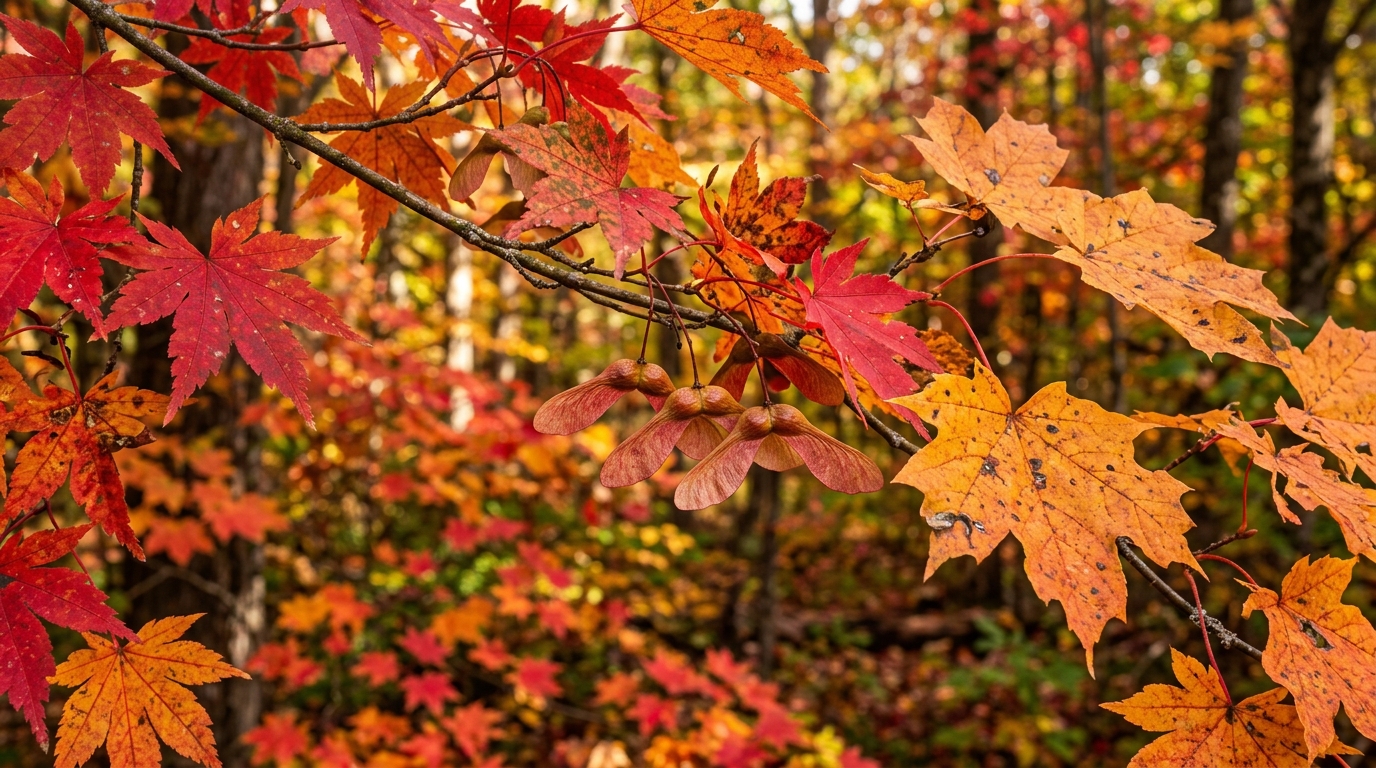
🍁 Dendrological Monograph: Genus Acer
An in-depth botanical study of the genus Acer (Sapindaceae), focusing on opposite phyllotaxy, palmate lobing variations, winged schizocarp (samara) aerodynamics, xylem sap pressurization dynamics, figure grain wood anatomy, and autumn anthocyanin pigmentation pathways.
The genus Acer, traditionally placed in its own family Aceraceae and now integrated into the soapberry family Sapindaceae, encompasses approximately 130 to 160 species of deciduous and semi-evergreen trees and shrubs distributed across the temperate zone of the Northern Hemisphere, with a single species (Acer laurinum) crossing the equator into the tropical mountains of Indonesia. Celebrated globally for their brilliant autumn foliar displays, iconic palmate foliage, valuable hardwood timber, and sweet spring sap, maples constitute a primary structural component of mixed mesophytic and northern hardwood forest communities across North America, Europe, and East Asia.
For botanists and field arborists, identifying maples begins with recognizing their strict foliar arrangement: maples are one of the few broadleaf tree lineages that possess opposite leaf arrangement (phyllotaxy), instantly distinguishing them from alternate-leaved families such as Fagaceae (oaks, beeches) and Rosaceae (cherries, apples). Furthermore, the unique winged fruit of the maple—botanically classified as a schizocarp of samaras, colloquially known as a ‘helicopter’ or ‘whirlybird’—exhibits remarkable aerodynamic properties that have inspired biomechanical research into autorotating flight dynamics. This treatise provides a comprehensive examination of maple taxonomy, comparative foliar morphology, spring sap physiology, wood properties, and ecological roles.
1. Taxonomic Diversity and the ‘MAD’ Branching Architecture
One of the first rules taught in introductory dendrology and field taxonomy is the ‘MAD’ mnemonic, which designates the three major woody tree families in northern temperate forests that feature opposite branching: Maple (Acer), Ash (Fraxinus), and Dogwood (Cornus)—often augmented to ‘MAD Horse’ to include the Horsechestnut and Buckeye family (Aesculus, Sapindaceae). When an arborist approaches a deciduous tree and observes that buds, leaves, and lateral branchlets emerge directly across from one another in opposing pairs at each stem node, the field of possible genera narrows drastically.
Within this opposite-leaved framework, maples are separated from ashes and dogwoods by simple leaf morphology. Ashes possess pinnately compound leaves (with the exception of single-leaf ash), while dogwoods display entire margins with distinct arcuate venation (veins that curve smoothly along the margin toward the apex). Maples, with few notable exceptions, display simple, palmately veined and palmately lobed leaves where primary structural veins radiate outward from the petiole junction like fingers from the palm of a hand. The primary North American exception to the simple leaf rule is the Boxelder (Acer negundo), which produces pinnately compound leaves bearing three to seven leaflets, frequently causing novice foragers to mistake it for Poison Ivy (Toxicodendron radicans), though its opposite arrangement immediately resolves the confusion.
Furthermore, East Asia represents the undisputed epicenter of maple evolutionary diversity, harboring more than two-thirds of all extant species. Species such as the Japanese Maple (Acer palmatum), Paperbark Maple (Acer griseum), and Manchurian Maple (Acer mandshuricum) exhibit breathtaking morphological diversity ranging from deeply dissected, lace-like palmately cleft leaves to trifoliate compound foliage paired with radiant copper-orange peeling bark. Understanding the evolutionary radiation of Acer reveals how this versatile genus adapted to understory, riparian, and canopy dominant niches across multiple continents.
| Maple Species | Common Name | Leaf Lobe Count & Shape | Sinus Character | Samara Angle | Bark Character (Mature) |
|---|---|---|---|---|---|
| Acer saccharum | Sugar Maple | 5 lobes, entire margins with few teeth | U-shaped sinuses (round) | 60° to 90° horseshoe angle | Deeply furrowed, vertical plates |
| Acer rubrum | Red Maple | 3-5 lobes, serrated/toothed margins | V-shaped sinuses (sharp) | 50° to 60° convergent angle | Flaky plates, shaggy with age |
| Acer saccharinum | Silver Maple | 5 deep lobes, silvery white underside | Deeply incised, rounded sinuses | 90° widely divergent angle | Shaggy, peeling vertical strips |
| Acer platanoides | Norway Maple | 5-7 broad lobes, sharp teeth | Wide, flattened sinuses | 160° to 180° near-horizontal | Tight, net-like diamond fissures |
| Acer pensylvanicum | Striped Maple | 3 shallow, forward-pointing lobes | Shallow V-shaped sinuses | Wide divergent angle | Smooth green bark with white stripes |
| Acer negundo | Boxelder | Compound (3-7 leaflets), coarsely toothed | Leaflets separated / cleft | Distinct V-shaped hanging clusters | Interlacing ridges, grayish-brown |
2. Comparative Identification: Sugar vs. Red vs. Norway Maple
In urban forestry and natural forest stands alike, distinguishing between Sugar Maple (Acer saccharum), Red Maple (Acer rubrum), and the introduced, invasive Norway Maple (Acer platanoides) is an essential diagnostic challenge. These three species frequently grow in close proximity, and their similarities have confounded generations of tree enthusiasts. However, several precise morphological markers provide unambiguous separation:
1. Sinus Geometry and Margin Serration: The classic memory key for separating Sugar Maple from Red Maple focuses on the letter shape formed by the leaf sinuses (the indentations between lobes). Sugar Maple features rounded, smooth, distinctly U-shaped sinuses, resembling the letter ‘U’ in ‘Sugar.’ Its margins are largely smooth with only a few large, blunt teeth. Red Maple, by contrast, displays sharp, jagged, V-shaped sinuses, resembling the letter ‘V,’ and the leaf margin is intensely serrated with dozens of fine, saw-like teeth throughout.
2. The Petiole Sap Test: To definitively separate Norway Maple from Sugar Maple when foliage is present, snap a leaf petiole cleanly in two and observe the exuding fluid. Norway Maple exudes a distinct, opaque, milky-white latex sap from the broken petiole within seconds. Sugar Maple, in sharp contrast, yields a completely clear, watery sap. Furthermore, Norway Maple leaves are typically broader than they are long, carrying seven distinct lobes compared to the five lobes typical of Sugar Maple.
3. Winter Bud Morphology: In the dormant season, inspect the terminal buds. Sugar Maple produces sharp, slender, conical, brown-to-tan buds resembling spearheads. Red Maple produces blunt, rounded, clustered, bright scarlet-red buds that swell noticeably in late winter. Norway Maple displays large, plump, rounded, deep purple-maroon buds that are substantially larger than those of native American maples.
4. Understory Specialists: Striped Maple and Mountain Maple: In northern montane woodlands, two native understory maples warrant special diagnostic attention: Striped Maple (Acer pensylvanicum, also called Moosewood) and Mountain Maple (Acer spicatum). Striped Maple features smooth, brilliant green bark vertically etched with vivid white ribbons, topped by large three-lobed ‘goose-foot’ leaves. Mountain Maple produces upright floral spikes (racemes) and coarsely pubescent twigs, growing in dense clumps along cool, rocky mountain streams.
3. Samara Aerodynamics and Autorotation Mechanics
The fruit of Acer is a double samara, which splits at maturity into two single-seeded, winged mericarps. Each samara is composed of a dense, rounded nutlet containing the seed embryo, attached to an asymmetrical, flattened fibrous wing formed from the expanded ovary wall. The leading edge of the wing is heavily thickened, reinforced by a dense bundle of structural fibers, while the trailing edge is thin and flexible.
When an acorn or nut drops from a tree canopy, it falls in a rapid ballistic trajectory directly beneath the parent crown. When a maple samara detaches, however, it undergoes autorotation—spinning rapidly around its center of mass like a helicopter rotor blade. Aerodynamicists and fluid dynamic physicists studying maple samaras have discovered that autorotation creates a stable, leading-edge vortex (LEV) on the upper suction surface of the rotating wing, identical to the aerodynamic lift vortex generated by foraging hummingbirds, bats, and hawkmoths.
This leading-edge vortex dramatically lowers air pressure above the wing, generating immense vertical lift that slows the terminal descent velocity of the falling samara to approximately 0.8 to 1.2 meters per second. This low descent velocity allows convective thermal air currents and horizontal ambient winds to carry the seed vast distances from the parent tree—frequently hundreds of meters away into newly opened canopy gaps, clearings, and forest edges, facilitating successful colonization of open terrain.
Samara Divergence Angles Across Species
The angle formed by the pair of samaras prior to separation represents a stable taxonomic indicator:
- Norway Maple (Acer platanoides): The two wings diverge at a wide, nearly horizontal angle spanning 160 to 180 degrees.
- Sugar Maple (Acer saccharum): The samaras form a horseshoe shape, diverging at an angle of roughly 60 to 90 degrees.
- Red Maple (Acer rubrum): The wings form a narrow, acute V-shape, typically spanning 50 to 60 degrees.
- Silver Maple (Acer saccharinum): The samaras are exceptionally large (often 4 to 6 centimeters long) and diverge at roughly 90 degrees, dropping in late spring rather than autumn.
4. Spring Sap Dynamics and Freeze-Thaw Pressurization
The phenomenon of maple sap flow in early spring—the physiological foundation of the maple syrup industry—is governed by a unique physical-biological mechanism known as the stem pressure or freeze-thaw pressurization cycle. While water transport in most trees during the active growing season operates under negative pressure (tension) driven by foliar transpirational pull, dormant maples in late winter generate massive positive internal pressures within their stem xylem, frequently exceeding 1.5 to 2.5 atmospheres (20 to 35 psi).
This positive pressurization requires a precise diurnal temperature oscillation: below-freezing ambient temperatures at night (typically -3 to -6 degrees Celsius), followed by daytime temperatures rising above freezing (4 to 8 degrees Celsius). The underlying mechanism operates within specialized, gas-filled fiber cells that surround the water-conducting xylem vessels:
- The Freezing Phase: As temperatures drop below freezing, water is drawn from the xylem vessels into the gas-filled fiber cells, where it freezes along the inner cell walls. This ice formation compresses the air bubbles inside the fibers and creates a cryogenic vacuum that draws water upward from the root system through the sapwood.
- The Thawing Phase: When the sun warms the tree trunk above freezing, the ice lining the fiber cell walls melts rapidly. The compressed air bubbles expand, forcing liquid sap out of the fibers and back into the xylem vessels under powerful positive pressure.
If an arborist, forester, or sugarmaker drills a taphole into the sapwood during this daytime thaw, the pressurized sap flows readily outward. Maple sap is composed of 97 to 98 percent pure water, 1.5 to 3 percent sucrose (synthesized during the previous summer and stored as starch in wood ray parenchyma before being enzymatically converted to sugar in late winter), along with trace minerals (calcium, potassium, magnesium), organic amino acids, and phenolic compounds. To produce one gallon of pure maple syrup (boiled to 66 degrees Brix), approximately 40 to 45 gallons of raw sap must be evaporated.
5. Wood Cellular Anatomy: Figured Grain, Bird’s-Eye, and Musical Luthier Uses
The cellular histology of maple timber exhibits a diffuse-porous hardwood structure. Unlike ring-porous oaks, where massive vessels are concentrated in earlywood bands, maples differentiate small, uniformly distributed vessels throughout the annual growth ring. This results in an exceptionally dense, smooth-grained, fine-textured wood that finishes to a porcelain-like polish with immense resistance to indentation and abrasive wear.
In high-grade Sugar Maple (Acer saccharum, commercially traded as ‘Hard Maple’ or ‘Rock Maple’), rare biological anomalies produce stunning visual grain figures highly prized by musical luthiers and fine furniture masters:
- Bird’s-Eye Maple: Characterized by hundreds of tiny, localized conical indentations in the vascular cambium that cause annual growth rings to dimple inward, resembling small bird eyes when slab-sawn. Geneticists and tree physiologists attribute bird’s-eye grain to localized viral infections, cambial bud suppression, or genetic mutations.
- Curly / Flame / Tiger Maple: Produced when wood fibers grow in a continuous sinusoidal undulating wave rather than a straight vertical line. When cut, the varying angle of light reflection across the wavy fibers creates a dramatic three-dimensional optical chatoyancy (flame effect). This wood is the historic standard for the backs, necks, and sides of fine violins, cellos, and archtop guitars.
- Quilted Maple: Found predominantly in Bigleaf Maple (Acer macrophyllum) of the Pacific Northwest, exhibiting broad, rounded, blister-like or rolling 3D ripples reminiscent of quilted fabric.
6. Autumn Senescence and Maple Decline Syndrome
The brilliant autumnal transformation of maple foliage represents a tightly regulated physiological sequence. As photoperiod (daylength) shortens in late summer, auxins synthesized in the leaf lamina decrease, triggering the development of an abscission zone at the base of the petiole. The active transport of nitrogen, phosphorus, and potassium from the leaf back into perennial woody tissues accelerates, and chlorophyll synthesis ceases.
With chlorophyll breakdown unmasking underlying carotenoid pigments (yielding rich yellow xanthophylls and orange carotenes), maples take a remarkable step: they actively synthesize new red and purple pigments known as anthocyanins within the vacuolar sap of their leaf mesophyll. This energetically costly synthesis of cyanidin-3-glucoside occurs under bright, sunny autumn days combined with crisp, cold, non-freezing night temperatures. Anthocyanins act as natural sunscreens (photoprotectants) and powerful free-radical scavenging antioxidants, shielding the delicate, degrading photosynthetic machinery from photoinhibition during the critical final hours of nutrient resorption before the leaf drops. In Sugar Maple and Red Maple, the interplay between bright yellow carotenoids and fiery red anthocyanins creates the world-renowned crimson, amber, and golden tapestries that define the deciduous forests of eastern North America and East Asia.
However, contemporary foresters are monitoring a troubling ecological challenge known as Maple Decline Syndrome. In northern hardwood stands, mature Sugar Maples are exhibiting canopy dieback, crown thinning, and premature mortality. Research reveals this is a complex disorder driven by multiple interacting stressors: atmospheric acid deposition (acid rain) that leaches vital calcium and magnesium cations from forest soils while mobilizing toxic aluminum ions; repeated defoliation by forest tent caterpillars (Malacosoma disstria); prolonged summer droughts that disrupt root ectomycorrhizal associations; and climate warming that reduces the protective winter snowpack, allowing deep soil frosts to freeze and sever delicate maple feeder roots. Mitigating maple decline requires landscape-level soil calcium restoration, careful harvest thinning, and aggressive reductions in regional industrial emissions.