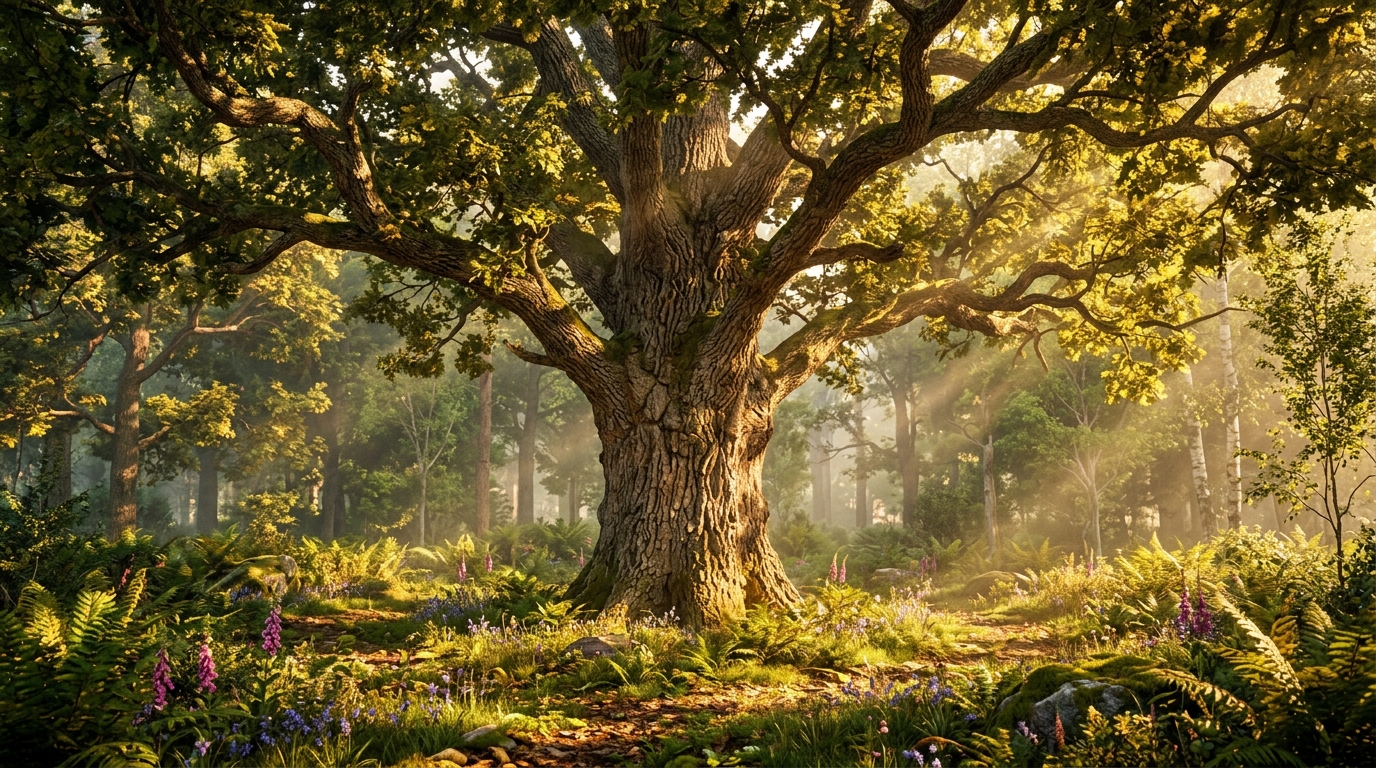
🌳 Dendrological Monograph: Genus Quercus
This monograph provides an exhaustive comparative taxonomic analysis of the genus Quercus (Fagaceae), detailing subgeneric classifications (Quercus vs. Cerris vs. Lobatae), leaf lobe morphologies, acorn maturation timelines, tyloses formation, and ecological keystone functions in temperate woodland biomes.
The genus Quercus, encompassing between 500 and 600 extant species within the beech family (Fagaceae), stands as one of the most ecologically influential, economically vital, and morphologically diverse lineages of woody angiosperms on Earth. Distributed predominantly across the temperate, subtropical, and tropical montane regions of the Northern Hemisphere, oaks dominate forest biomes extending from the boreal margins of North America and Eurasia to the cloud forests of the Mesoamerican cordilleras and Southeast Asian archipelagos. The evolutionary success of Quercus is attributed to exceptional physiological plasticity, profound adaptations to drought and fire disturbance regimes, intricate ectomycorrhizal symbioses, and a specialized reproductive strategy centered on the production of tannin-rich, single-seeded nutritive nuts known as acorns.
For field arborists, foresters, and dendrologists, mastering the identification and silvicultural ecology of oak species is foundational. Distinguishing among sympatric oak taxa requires an understanding of subgeneric classification, micro-morphological leaf structures, bark texture evolution, cupule architecture, and phenological rhythms. Furthermore, oak species form the structural backbone of keystone forest ecosystems, sustaining thousands of associated organisms ranging from specialized lepidopteran larvae and canopy-nesting raptors to soil microbial consortia and wild ungulates. This dissertation delivers an in-depth botanical breakdown of global oak taxonomy, comparative diagnostic anatomy between major sections, wood cellular histology, and long-term forest management practices.
1. Taxonomic Architecture: Subgeneric Divisions of Genus Quercus
Modern phylogenetic systematics classifies the genus Quercus into two primary subgenera: subgenus Quercus and subgenus Cerris. These subgenera are further divided into eight distinct sections based on comprehensive molecular genomic sequencing, nuclear ribosomal DNA analysis, and micro-morphological traits including stomatal architecture, pollen exine sculpturing, and cotyledon morphology. In temperate North American and European forests, field dendrologists encounter three primary sections: section Quercus (the white oaks), section Lobatae (the red and black oaks), and section Protobalanus (the intermediate or golden cup oaks).
Section Quercus (White Oaks) represents a cosmopolitan lineage characterized by rounded leaf lobes devoid of bristle tips, sweet or low-tannin acorns that mature within a single growing season, and wood anatomy filled with abundant tyloses—balloon-like cellular outgrowths that occlude large xylem vessels. Representative species include the Eastern White Oak (Quercus alba), English Oak (Quercus robur), Sessile Oak (Quercus petraea), Bur Oak (Quercus macrocarpa), and Chestnut Oak (Quercus montana). Because acorns of section Quercus possess low concentrations of bitter tannic acid and germinate almost immediately upon autumn seedfall (frequently producing a radicle within days of contacting mineral soil), they represent an immediate, highly preferred caloric food source for granivorous wildlife.
In contrast, Section Lobatae (Red and Black Oaks) is an exclusively New World clade characterized by leaves bearing sharp, spine-like bristle tips at the terminations of lobes and vein junctions. Their acorns require two full growing seasons (approximately 18 months) to reach reproductive maturity, remaining as tiny, undeveloped embryonic structures on current-year twigs through the first winter before completing expansion and fertilization in late summer of the second year. Prominent taxa include Northern Red Oak (Quercus rubra), Pin Oak (Quercus palustris), Black Oak (Quercus velutina), Scarlet Oak (Quercus coccinea), and Southern Live Oak (Quercus virginiana, classified within section Virentes). The acorns of Lobatae species contain high concentrations of astringent polyphenols and lipid compounds, preventing premature autumn germination and requiring prolonged winter stratification (chilling) to break physiological embryo dormancy.
| Taxonomic Section | Common Group | Leaf Lobe Apex | Acorn Maturation | Tannin Level | Xylem Tyloses | Geographic Range |
|---|---|---|---|---|---|---|
| Section Quercus | White Oak Group | Rounded, no bristles | 1 Season (Annual) | Low to Moderate | Abundant / Occluded | North America, Europe, Asia |
| Section Lobatae | Red Oak Group | Sharp bristle tips | 2 Seasons (Biennial) | High (Astringent) | Sparse / Open pores | North, Central & South America |
| Section Cerris | Turkey Oak Group | Mucronate to bristle | 2 Seasons (Biennial) | High | Sparse | Eurasia, North Africa |
| Section Protobalanus | Golden Cup Oaks | Spiny dentate / Entire | 2 Seasons (Biennial) | Moderate to High | Variable | Southwestern North America |
| Section Ilex | Holm Oak Group | Spinose or entire evergreen | 1 or 2 Seasons | High | Moderate | Mediterranean, Eurasia |
| Section Virentes | Live Oak Group | Entire, revolute margins | 1 Season (Annual) | Moderate | Dense / Compact | Southeastern North America, Cuba |
2. Comparative Foliar Morphology and Diagnostic Keys
Leaf morphology in Quercus exhibits remarkable intra-specific phenotypic variation and heterophylly, making identification challenging yet deeply rewarding. Leaves on juvenile saplings, epicormic sprouts, and lower shaded branches frequently diverge substantially from the stabilized, sun-exposed foliage of the upper canopy. Sun leaves generally exhibit deeper sinuses, thicker cuticular waxes, and increased stomatal density, whereas shade leaves are broader, thinner, and less deeply lobed to maximize photon capture under diffuse canopy light regimes.
When executing field identification, dendrologists examine several critical foliar parameters: petiole length, margin lobing, presence or absence of bristle tips, pubescence on the abaxial (underside) epidermis, and secondary venation patterns. In Quercus alba, leaves are distinctly obovate to oblong, featuring seven to nine finger-like, rounded lobes separated by variable sinuses that can be shallow or incised nearly to the midrib. The abaxial surface is glaucous (pale blue-green) and glabrous at maturity. Conversely, in Quercus rubra, the leaves possess seven to eleven lobes with sharp, bristled tips, and the sinuses generally extend roughly halfway to the midrib, displaying a characteristic U-shaped geometry.
Hair structures (trichomes) on the abaxial leaf surface provide vital microscopic clues. For instance, Black Oak (Quercus velutina) frequently displays scurfy, stellate (star-shaped) pubescence along the vein axils and abaxial lamina, accompanied by large, distinctly angled, pubescent winter buds. Chestnut Oak (Quercus montana) displays crenate, coarsely toothed margins resembling those of American Chestnut (Castanea dentata), but can be readily separated from Chinquapin Oak (Quercus muehlenbergii) by examining leaf teeth geometry: Q. montana features rounded, blunt teeth, whereas Q. muehlenbergii displays sharp, mucronate teeth terminating in small, glandular points.
3. Acorn Anatomy, Cupule Morphology, and Reproductive Phenology
The fruit of an oak tree is an acorn—a specialized botanical structure consisting of a hard, leathery pericarp enclosing a single large seed (rarely two), surrounded at its base or partially enclosed by a cup-shaped involucre known as the cupule. The cupule is derived from modified, hardened floral bracts (scales) that coalesce during ovary development. Morphological variations in cupule scale size, thickness, orientation, and surface pubescence represent definitive taxonomic characters for species-level determination.
In Bur Oak (Quercus macrocarpa), the common name directly reflects its enormous fruit (from Greek macro meaning large, and carpos meaning fruit). The cupule of Q. macrocarpa covers one-half to nearly the entire surface of the nut, lined along its upper rim with prominent, moss-like fringe filaments formed by prolonged, awn-like scale extensions. In English Oak (Quercus robur), the acorns are borne on distinct, elongated peduncles measuring two to eight centimeters in length (hence the alternate common name ‘Pedunculate Oak’), while the closely related Sessile Oak (Quercus petraea) bears acorns that sit almost directly on the twig without peduncles (sessile), paired with leaves that possess distinct, prominent petioles.
Acorn production in oak forests is notoriously irregular, governed by masting cycles. Every two to seven years, oak stands experience synchronized mast years characterized by immense, super-abundant crops of viable acorns, interspersed with years of near-total reproductive dormancy. Evolutionary biologists attribute masting to the ‘predator satiation hypothesis.’ By synchronizing massive seed crops over regional landscapes, oaks overwhelm the predatory feeding capacity of seed consumers—such as weevils (Curculio spp.), rodents, wild boar, and wild turkeys—ensuring that a substantial percentage of acorns escape consumption to successfully germinate and establish sapling advance regeneration.
The Chemistry of Acorn Tannins and Stratification Requirements
Tannins represent a class of astringent, polyphenolic secondary metabolites synthesized within the parenchymatous tissue of the acorn pericarp and embryonic cotyledons. Functionally, high tannin concentrations serve as potent chemical defenses against fungal decay organisms, bacterial pathogens, and mammalian herbivores. In section Lobatae, tannin concentrations can reach 8 to 12 percent of dry weight, imparting an intensely bitter flavor that discourages consumption until cold winter temperatures and microbial action leach polyphenols from the seed coats.
From a silvicultural propagation standpoint, white oak acorns must be gathered immediately following drop and planted without delay or maintained under high humidity without chilling, as the embryo will push a primary taproot into damp substrata within days. If permitted to desiccate below 25 to 30 percent moisture content, white oak embryos suffer catastrophic physiological mortality. Red oak acorns, on the other hand, require 60 to 90 days of moist cold stratification at 1 to 4 degrees Celsius to break internal dormancy mechanisms mediated by abscisic acid (ABA), triggering endogenous gibberellin synthesis that catalyzes embryo development in the subsequent spring.
4. Cellular Wood Anatomy: Tyloses, Ring Porosity, and Dendrochronology
The wood anatomy of Quercus represents a masterwork of structural biomechanics and hydraulic transport architecture. Oaks are ring-porous hardwoods, meaning that at the onset of vernal cambial reactivation in early spring, the vascular cambium differentiates exceptionally large, open vessel elements in the earlywood zone to transport large volumes of sap from root networks to newly expanding foliage. As the growing season advances into late summer, the cambium shifts production to much smaller, thick-walled vessel elements and dense libriform fibers in the latewood zone, conferring immense compressive strength, stiffness, and structural resilience against gravitational and wind-loading stresses.
A profound histological distinction between white and red oaks lies in the development of tyloses within the earlywood vessel lumina. In section Quercus, adjacent ray and axial parenchyma cells produce protoplasmic balloon-like outgrowths that push through pit membranes, expanding into the wide lumens of mature earlywood vessels. These tyloses completely block and seal the vessels within one to two seasons of formation, creating an impermeable barrier against air embolism, fungal hyphal penetration, and fluid movement. This morphological trait makes white oak timber completely watertight, rendering it the historical material of choice for marine shipbuilding, tight cooperage (wine and whiskey aging casks), and exterior architectural carpentry. In red oak wood, by contrast, tyloses are virtually absent; earlywood vessels remain open, hollow capillary tubes through which liquids and air pass with minimal resistance, precluding its use in cooperage without chemical sealing.
Because oak trees are exceptionally long-lived—frequently attaining chronological ages between 300 and 1,000 years in species such as Quercus robur, Quercus petraea, and Quercus alba—their annual growth rings serve as pristine ecological archives. Dendrochronologists analyze oak tree rings to reconstruct past paleoclimatic variations, severe historical drought anomalies (such as the megadroughts of medieval Europe and pre-Columbian North America), and past fire return intervals. Cross-dating oak timber from ancient archaeological structures has established continuous dendrochronological master sequences spanning more than 10,000 years into the Holocene epoch.
🔍 Silvicultural Diagnostic Tip: Winter Twig Key
During dormant winter surveys when foliage is absent, distinguish between White Oak and Red Oak groups by examining terminal bud clusters and branchlet scars. White oaks feature rounded, obtuse buds clustered at the twig tip with brown or reddish scales lacking hairs. Red oaks feature sharp, pointed, frequently angled buds (such as the 5-angled, velvety pubescent buds of Quercus velutina). Furthermore, branches on white oaks exhibit pale ash-gray scaly bark with shallow fissures, whereas northern red oak displays distinctive flat, shiny ‘ski-trail’ ridges along the upper trunk.
5. Silvicultural Management and Forest Regeneration Dynamics
In modern silviculture, maintaining oak dominance in temperate mixed broadleaf forests poses significant operational challenges. Across both North America and Europe, many historic oak-dominated stands are undergoing rapid mesophication—an ecological transition characterized by the canopy replacement of shade-intolerant, fire-adapted oaks by shade-tolerant, mesic tree species such as Red Maple (Acer rubrum), Sugar Maple (Acer saccharum), American Beech (Fagus grandifolia), and European Beech (Fagus sylvatica). This transition is propelled by fire suppression policies implemented over the past century, high white-tailed deer browsing pressures that preferentially target oak seedlings, and closed-canopy single-tree selection harvesting systems that provide insufficient sunlight for oak sapling recruitment.
Oaks are fundamentally light-demanding, disturbance-dependent species. Regeneration silviculturists employ specific harvesting and management regimes to foster oak advance regeneration before executing final overstory removals:
- Shelterwood Harvesting: The shelterwood system is the premier silvicultural method for oak regeneration. In the preparatory and seed cuts, foresters remove competing intermediate and midstory shade-tolerant trees, admitting 40 to 60 percent ambient sunlight to the forest floor. This level of illumination satisfies the photosynthetic compensation point of oak seedlings while suppressing shade-tolerant competitors. Once a dense stocking of robust oak advance regeneration (defined as seedlings with taproot ground-line diameters exceeding 10 to 12 millimeters) is established, the remaining shelterwood overstory is harvested in one or two final entries.
- Prescribed Fire Regimes: Periodic low-intensity surface fires represent an indispensable ecological tool. Oak seedlings possess massive root systems with expansive carbohydrate reserves stored within deep taproots, enabling them to vigorously resprout from the root collar following top-kill by fire. In contrast, thin-barked mesic competitors such as young maples and beeches sustain fatal cambial girdling during surface fires, resetting succession in favor of oak dominance.
- Herbivory Mitigation: In regions with hyper-abundant ungulate populations, overbrowsing eliminates oak seedlings before they can achieve recruitment height (exceeding 1.5 meters). Effective management requires targeted recreational hunting pressure, the installation of high-tensile woven wire deer exclosure fences, or individual rigid polypropylene seedling shelters.
Through systematic silvicultural planning, informed dendrological selection, and proactive ecological stewardship, forest managers and conservationists can preserve the majesty, structural complexity, and boundless biodiversity of native oak forests for centuries to come.