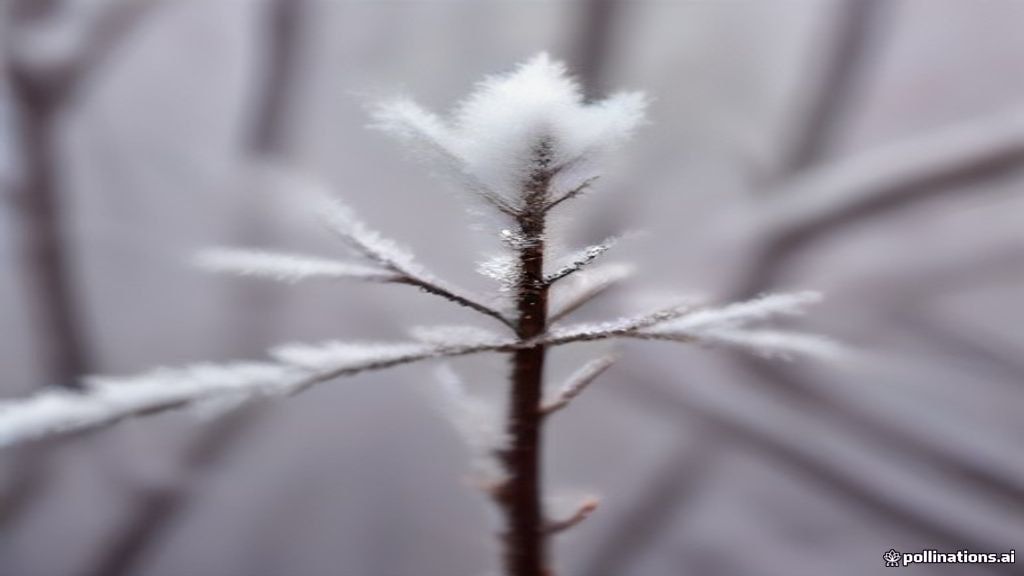
❄️ Winter Dendrology Manual: Twig Morphology
A forensic botanical guide to identifying leafless trees and shrubs using dormant winter twigs. Examines true vs. false terminal buds, bud scale anatomy, leaf scar shapes, vascular bundle trace counts, continuous vs. chambered piths, and winter dichotomous keys.
When winter descends upon temperate forests, deciduous canopies strip down to their bare structural skeletons. For casual nature enthusiasts, this seasonal leafless state presents an insurmountable barrier to species recognition. However, for the trained dendrologist and professional arborist, winter transforms the forest into a classroom of exquisite, microscopic diagnostic clarity. Free from the obscuring mass of summer foliage, the ultimate taxonomic secrets of woody angiosperms and gymnosperms are legibly displayed along the terminal branchlets of the tree: the dormant winter twigs.
Every twig is an anatomical masterpiece. Within a short ten-centimeter segment of current-year stem, a tree permanently preserves the geometric record of its leaf arrangement, the vascular vascular plumbing of its discarded foliage, the cellular architecture of its internal aeration and water-storage tissues, and the embryonic primordia of the coming spring’s leaves and blossoms. While leaf size and color can vary widely in response to shade, drought, or soil nutrient stress, twig characters—such as bud scale arrangements, leaf scar shapes, bundle scar counts, and pith structures—are rigidly conservative phylogenetic traits. This monograph provides an exhaustive illustrated guide to winter twig dendrology, detailing the cellular anatomy, diagnostic keys, and identification procedures for northern temperate woody flora.
1. The Anatomy of a Dormant Winter Twig: Essential Landmarks
To successfully navigate a winter twig identification key, an arborist must master the precise anatomical vocabulary of dormant branchlet morphology. When examining a twig with a 10x botanical hand lens, several universal landmarks must be evaluated:
1. Terminal Buds (Apical Buds): Positioned at the very apex of the twig, the terminal bud contains the embryonic shoot apical meristem that will drive vertical shoot elongation in the coming spring. Buds are categorized into two fundamental anatomical types:
- True Terminal Bud: A distinct, fully developed apical bud that terminates the seasonal growth axis directly in line with the stem. A true terminal bud is accompanied at its base by the final lateral bud of the season. Classic examples: Oaks (Quercus), Maples (Acer), Poplars (Populus), and Hickories (Carya).
- False Terminal Bud (Pseudoterminal Bud): Produced when the shoot exhibits determinate sympodial growth. In mid-summer, the delicate tip of the growing shoot aborts, withers, and falls off, leaving a tiny, round branchlet abscission scar (stem scar) immediately adjacent to the uppermost lateral bud. This uppermost lateral bud is pushed slightly off-center and assumes the functional role of the terminal bud. Genera with false terminal buds include Elms (Ulmus), Birches (Betula), Willows (Salix), Basswood (Tilia), and Redbud (Cercis).
2. Bud Scales (Perulae): Modified embryonic leaves that encase and protect delicate embryonic tissues from winter desiccation, physical abrasion, and ice injury. Buds are classified as:
- Imbricate: Multiple overlapping scales that shingle over each other like roof tiles (e.g., Oaks, Beeches, Maples).
- Valvate: Two (rarely three) scales that meet edge-to-edge along a straight vertical seam without overlapping, resembling the clamshell doors of a cabinet (e.g., Tulip Poplar Liriodendron, Striped Maple, Dogwood floral buds).
- Naked (Non-scaled): Entirely lacking protective bud scales; embryonic leaves are exposed directly to winter air, protected only by a dense coat of velvety trichomes (e.g., Bitternut Hickory Carya cordiformis, Pawpaw Asimina triloba, Witch-hazel Hamamelis virginiana).
- Cap-like (Univalvate): Enclosed by a single, solid hood-like scale that must be shed like a cap when the bud swells (e.g., Willows Salix).
3. Leaf Scars and Vascular Bundle Scars: When a leaf abscises in autumn, the healed wound on the twig leaves a permanent scar termed the leaf scar. Inside the boundary of the leaf scar lie one or more tiny raised dots or crescents: the bundle scars (bundle traces), which represent the severed, suberized ends of the vascular xylem and phloem bundles that delivered water to the leaf lamina.
| Twig Diagnostic Feature | Diagnostic States / Variations | Key Identifying Question | Representative Genera | Key Diagnostic Pitfall |
|---|---|---|---|---|
| Terminal Bud Presence | True vs. False (Pseudoterminal) | Is there an abscission scar beside the bud? | True: Quercus, Acer; False: Ulmus, Tilia | Look closely with 10x lens for tip scar |
| Bud Scale Structure | Imbricate, Valvate, Naked, Cap-like | Do scales overlap, meet at seam, or absent? | Valvate: Liriodendron; Naked: Carya cordiformis | Single cap scale: unique to Salix (Willow) |
| Leaf Scar Shape | Shield, Horseshoe, U-shape, Heart, Triangular | What is the 2D geometric outline of scar? | Horseshoe: Aesculus; Shield: Fraxinus; Crescent: Acer | Scar size shrinks on slow-growing spurs |
| Bundle Scar Count | 1, 3, 5, 7, or numerous scattered | How many vascular dots inside the scar? | 1: Ginkgo, Sassafras; 3: Acer, Betula; Many: Fraxinus | Count all dots carefully; don’t guess |
| Pith Structure | Solid, Chambered, Diaphragmed, Spongy | What is inside longitudinal twig cross-section? | Chambered: Juglans; Diaphragmed: Nyssa | Must slice twig length-wise with sharp razor |
| Pith Cross-Section | Round, 5-angled (Star), Triangular | What shape is pith in transverse cut? | Star: Quercus, Populus; Triangular: Alnus | Cut fresh 2-year old wood for best clarity |
2. Leaf Scars and Bundle Traces: The Vascular Fingerprint
The morphology of leaf scars and bundle traces provides definitive diagnostic separation. For example, comparing the leaf scars of the four ‘MAD Horse’ opposite-branched families demonstrates the precision of this system:
- Horsechestnut and Buckeye (Aesculus): Produces massive, conspicuous, heart-shaped or shield-shaped leaf scars up to 12 millimeters across. Inside each scar sit 3 to 7 prominent bundle traces arranged in an open curved line, remarkably mimicking the nail holes around the edge of an inverted horseshoe.
- Ash (Fraxinus): Features large, pale, semicircular or shield-shaped leaf scars. In White Ash (Fraxinus americana), the upper margin of the leaf scar is deeply notched or concave, curling around the base of the terminal bud like the letter ‘U’. In Green Ash (Fraxinus pennsylvanica), the upper margin of the scar is straight or flattened, and the lateral bud sits atop the scar rather than embedded within it. In both species, bundle traces form a continuous curved line of dozens of microscopic dots.
- Maple (Acer): Leaf scars are narrow, V-shaped or crescent-shaped, encircling approximately half of the twig circumference. Symmetrical pairs of leaf scars on opposite sides of the twig frequently connect at their tips, forming a continuous raised collar around the stem. Maples consistently display exactly three bundle scars per leaf scar.
- Dogwood (Cornus): Leaf scars are tiny, elevated on persistent woody leaf bases (pseudopetioles) that meet in a raised ring, bearing three bundle scars.
3. Internal Pith Architecture: Solid, Chambered, and Diaphragmed
When exterior bud and scar characters leave doubt, a dendrologist pulls out a sharp razor knife, slices the twig longitudinally through its exact center, and examines the central spongy core: the pith. Composed of soft, parenchymatous tissue that occupied the center of the primary shoot, pith exhibits four distinct internal architectures:
1. Solid (Continuous): The interior of the pith is solid, uniform, and filled with unbroken parenchymatous cells throughout its entire length. This is the standard condition in over 85 percent of all temperate woody trees, including oaks, maples, birches, and elms.
2. Chambered Pith: The central pith tissue has torn horizontally during elongation growth, leaving empty, ladder-like air chambers separated by thin, transverse, papery cross-walls. Chambered pith is the undisputed diagnostic signature of the Walnut family (Juglandaceae):
- Black Walnut (Juglans nigra): Displays light-brown, buff-colored chambered pith separated by delicate cross-walls.
- Butternut / White Walnut (Juglans cinerea): Displays deep, dark chocolate-brown chambered pith, accompanied by a velvety ‘mustache’ of dense glandular hairs lining the upper border of the leaf scar.
3. Diaphragmed Pith: The pith is solid parenchymatous tissue throughout, but it is periodically traversed by distinct, hard, horizontal plates of lignified sclerenchyma cells. Slicing through a diaphragmed pith reveals a solid core with dark, firm horizontal cross-stripes. Classic examples include Black Tupelo / Gum (Nyssa sylvatica) and Tulip Poplar (Liriodendron tulipifera).
4. Star-Shaped and Triangular Transverse Cross-Sections: Slicing a twig transversely (perpendicular to length) reveals the cross-sectional geometry of the pith cylinder. In Oaks (Quercus), Poplars (Populus), and American Chestnut (Castanea), the pith cross-section is distinctly five-angled or star-shaped (pentagonal). In Alders (Alnus), the pith is sharply triangular (3-angled). In maples, ashes, and beeches, the pith is round.
Hickory Terminal Buds: The Sovereign Winter Monarchs
Among all northern temperate broadleaf trees, the genus Carya (Hickories) produces the most structurally dramatic winter buds. Shagbark Hickory (Carya ovata) features enormous terminal buds (up to 20 mm long) clad in dark brown, loose outer scales that taper to long, sharp points, with velvety, pale inner scales that expand into flower-like petals in spring. Mockernut Hickory (Carya tomentosa) displays massive, rounded, densely pubescent buff-colored buds on stout, hairy twigs. Conversely, Bitternut Hickory (Carya cordiformis) is immediately identified by its brilliant sulfur-yellow, naked buds that look like long, flattened yellow fingers on the twig.
4. Chemical Scents and Exudates in Winter Twigs
Field botanists frequently supplement visual examination with olfactory and tactile tests. Scraping the epidermis of a winter twig with a thumbnail liberates volatile organic chemicals synthesized in cortical resin cells:
- Wintergreen (Methyl Salicylate): Scraping twigs of Yellow Birch (Betula alleghaniensis) or Sweet Birch (Betula lenta) releases a powerful, refreshing wintergreen aroma.
- Bitter Almond (Benzaldehyde / Cyanide): Scraping twigs of Black Cherry (Prunus serotina) or Chokecherry (Prunus virginiana) releases an unmistakable bitter almond fragrance produced by the enzymatic hydrolysis of the cyanogenic glycoside prunasin.
- Citrus and Safrole: Twigs of Spicebush (Lindera benzoin) and Sassafras (Sassafras albidum) release sweet, spicy citrus and herbal perfumes.
- Resinous Turpentine: Conifer branchlets and Sweetgum twigs exude balsamic, terebinthine aromas from fractured resin ducts.
5. Constructing a Forensic Winter Dichotomous Key
By integrating phyllotaxy, bud morphology, and pith architecture, dendrologists execute winter identifications with absolute taxonomic certainty:
- Leaf scars and buds opposite → Go to Step 2
Leaf scars and buds alternate → Go to Step 3 - Terminal bud large, horseshoe leaf scar with 3-7 bundle traces → Aesculus (Buckeye)
Leaf scars crescent, exactly 3 bundle traces → Acer (Maple)
Leaf scars shield-shaped, bundle traces forming a continuous line → Fraxinus (Ash) - Pith chambered with transverse cross-walls → Juglans (Walnut/Butternut)
Pith diaphragmed with solid cross-plates → Liriodendron or Nyssa
Pith solid, continuous throughout → Go to Step 4 - Pith 5-angled (star-shaped) in cross-section; buds clustered at twig tip → Quercus (Oak)
Pith triangular in cross-section; male catkins persistent on bare twigs → Alnus (Alder)
Pith round; bud long, slender, spear-like with 10+ scales diverging at 45° → Fagus grandifolia (Beech)
Pith round; single cap-like scale enclosing each bud → Salix (Willow)
With this forensic key in hand, an arborist walks through leafless winter woods with the same confidence and accuracy as a botanist surveying a midsummer garden in full bloom.
6. Stipules and Stipular Scars: Diagnostic Rings Around Twigs
Stipules are leaf-like or scale-like appendages born in pairs at the base of the petiole. When stipules fall off in spring or autumn, they leave behind stipular scars on the twig surface. In the vast majority of woody trees, stipular scars are small, indistinct dots flanking the leaf scar.
However, in two major primitive angiosperm families, stipules encircle the entire stem, leaving an extraordinary diagnostic signature: a continuous circular ring scar completely girdling the circumference of the twig at every node. This complete encircling stipule ring is the universal signature of the Magnolia family (Magnoliaceae, including Magnolia and Liriodendron) and the Sycamore family (Platanaceae). If you pick up a winter twig and observe continuous rings running around the stem like bamboo nodes, your diagnostic search is immediately restricted to these two ancient families.
7. Spur Shoots and Brachyblast Dwarf Branch Architectures
In several temperate tree lineages, vegetative elongation is divided between long shoots (auxiblasts) and extreme dwarf shoots (brachyblasts or spur shoots). Spur shoots grow at glacial rates—frequently extending only 0.5 to 1.5 millimeters per year—leaving decades of compressed, ring-like terminal bud scale scars stacked tightly together like a stack of tiny coins.
Prominent examples include Ginkgo (Ginkgo biloba), Larches (Larix), Apples and Crabapples (Malus), Pears (Pyrus), and Sweet Birch (Betula lenta). On mature fruit trees and birches, spur shoots are the specialized reproductive factories where floral buds are concentrated. Recognizing spur shoot morphology allows an arborist to distinguish productive mature fruiting wood from rapid non-flowering vegetative water sprouts.
Furthermore, because each cluster of bud scale scars corresponds to exactly one annual growing season, an arborist can non-destructively age a dwarf spur shoot simply by counting the number of scar ridges with a 10x hand lens. On ancient Ginkgo trees, individual spur shoots measuring less than 5 centimeters in length have been documented carrying over 40 to 60 consecutive annual growth rings, testifying to the extreme morphological conservatism and cellular longevity of dwarf branchlet meristems.